RSS
Showing posts with label Cairo. Show all posts

Muhammad Ali Mosque, Cairo, Egypt

Completed in 1848, the Ottoman-style Mohammed Ali Mosque or Alabaster Mosque is more noticeable in each of Cairo, for more than 150 years it has dominated the skyline.
HistoryMuhammad Ali when he took over the Ottoman 'force majeure in the 1800s that all the buildings from the Mamluk castle was destroyed and rebuilt completely.
The castle today is the vision of the appearance of Muhammad Ali Pasha, and especially the mosque that bears his name. It was built between 1824 and 1848, and domes had to be rebuilt in the 1930s.
What to seeThe law prohibits anyone but the Ottoman sultan to build a mosque and minaret, and one or more, but this mosque has two minarets.This was one of the first indicators of Muhammad Ali that he does not intend to remain submissive to Istanbul.

Turkish mosque in the classic style, which reflects the assets the Ottoman Empire. Cascading domes, slender minarets, the constellation of the world hanging lamps, decorative ceiling spacious and recall all the great mosques in Istanbul.
Interior also reflects some of the effects of the French Rococo, and finished with decorative lines of red, green and gold. There are niche scalloped gold and two platforms (platforms): the one faced in marble and the other, more unusual, in the style of modern art.
Muhammad Ali was buried under a monument of white marble on the right of the entrance behind the grill and bronze.
In the courtyard of the ornate clock made by Louis Philippe in exchange for the obelisk that stands in the Place de la Concorde in Paris. It did not work.
Also in the courtyard is a Turkish Baroque ablution fountain, in which The Rough Guide to Egypt describes as "like a giant Easter egg Holiday "....

The Pharaonic Village in Cairo , Egypt


The Pharaonic Village was founded by Dr. Hassan Ragab Ph.D., who was the person who rediscovered the ancient Egyptian art of paper – making (Papyrus).


The Pharaonic Village is Egypt's historic park. It's a unique place where Egypt's entire history is explained in 2 to 3 hours including our ancient history as well as our modern history. Visiting The Pharaonic Village is recommended to be at the beginning of the trip to Egypt. It is located on an island in the Nile, just 3 miles south of the center of Cairo. In this village you are transported by floating amphitheaters, and a hundred actors and actresses demonstrate scenes from ancient Egypt (Papyrus making, sculpting, home building….etc.).

Abdeen Palace Museum, Cairo, Egypt

Abdeen Palace (Arabic: قصر عابدين) is one of the official residences of the President of Egypt.


Address: Moustafa Abdel Raziq Street, off Abdeen Square,


Zone/Area: Cairo


Phone: +20 2 391 0042


Construction


Construction started in 1863 and continued for 10 years but the palace was officially inaugurated in 1874. Erected on an area of 24 feddans, the palace was constructed by the French architect Rousseau along with a large number of Egyptian, Italian, French and Turkish decorators. However, the palace’s garden was added in 1921 by Sultan Fuad I on an area of 20 feddans. The cost of building the palace reached 700,000 Egyptian pounds in addition to 2 million pounds for its furnishing. More money was also spent on the palace’s alteration, preservation and maintenance by consecutive rulers. The palace includes 500 rooms.

Khan el-Khalili bazaar Market in Cairo , Egypt

How could a market in Egypt be responsible for the founding of the United States? Khan el-Khalili, once known as the Turkish bazaar during the Ottoman period, is now usually just called the 'Khan', and the names of it and the Muski market are often used interchangeably to mean either. Named for the great Caravansary, the market was built in 1382 by the Emir Djaharks el-Khalili in the heart of the Fatimid City. Together with the al-Muski market to the west, they comprise one of Cairo's most important shopping areas. But more than that, they represent the market tradition which established Cairo as a major center of trade, and at the Khan, one will still find foreign merchants. Perhaps, this vary market was involved in the spice monopoly controlled by the Mamluks, which encouraged the Europeans to search for new routes to the East and led Columbus, indirectly, to discover the Americas. During its early period, the market was also a center for subversive groups, often subject to raids before the Sultan Ghawri rebuilt much of the area in the early 16th century. Regardless, it was trade which caused Cairo's early wealth, even from the time of the Babylon fort which was often a settlement of traders.

Al-Azhar Park in Cairo

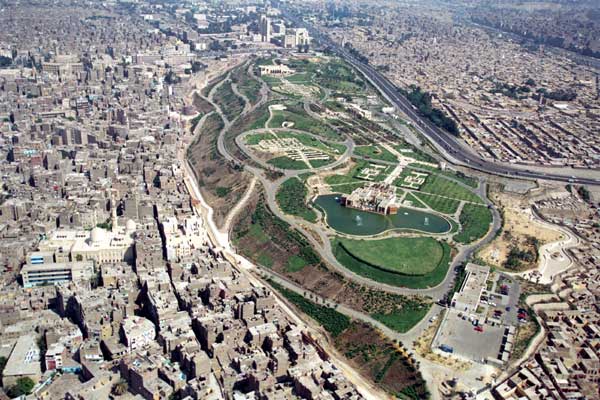
The Al-Azhar Park is important for tourists to Egypt because this hilly site is surrounded by the most significant historic districts of Islamic Cairo. This is one of the primary destinations for many visitors to the city, and this new park located in its heart provides many advantages, including a wonderful view of the surrounding area.


The creation of the 30 hectare (74 acre) Al-Azhar Park on Al-Darassa, by the Aga Khan Trust for Culture, came when his highness the Aga Khan decided to donate a park to the citizens of Cairo in 1984, out of the Islamic belief that we are all trustees of God’s creation and therefore must seek to leave the world a better place than it was before us. This decision was made during the 1984 conference “The Expanding Metropolis: Coping with Cairo’s Urban Growth.”

The Cairo Tower in Cairo, Egypt

Its nice to be up high in Cairo. It gives one a prospective view of this great city, with it's very modern and very ancient districts. Anyone who has stood atop the Citadel or from the upper floors of some of the taller hotels is aware of the grand views that Cairo offers.


One of the best views is from the Cairo Tower, located on Gezira Island (Zemalak) just north of the Museum of Modern Art (which is also very much worth a visit), which provides a panoramic vision of Cairo. This 187 meter tall tower, in the form of a latticework tube that fans out slightly at the top, is said to imitate a lotus plant, and ranks only fourth among the worlds highest towers. It is made of granite,  the same material often used by the ancient Egyptians, and is about 45 meters taller than the Great Pyramid at Giza.

Ibn Tulun in Cairo, Egypt

Tulun himself was a Turkish slave from Bokhara who was given to Caliph Mamun in 815 AD as a present. Afterwards, he became a powerful and influential person in the court of Mamun, allowing his son Ahmad Ibn Tulun (ibn means son of) to be well educated in the best traditions of Islamic law and government. As a young man, Ahmad was a loyal servant to his caliph in Samarra (north of modern Baghdad), Mesopotamia and when his father died and his stepfather was given Egypt as a sort of private estate by the caliph, Ahmad Ibn Tulun was sent to administer the country.


Ibn Tulun's appointment as prefect of Egypt came in 868 and at the end of a long period of political strife. The Bashmurite rebellion of 832 in the Nile River delta between the river's Rosetta and Damietta branches was the last and most violent of the Christian uprisings in Egypt. Caliph Mamun himself has spend forty-nine days in Egypt taking part in its suppression. Maqrizi, a well known historian of that period, says that, "From then on, the Copts were obedient and their power was destroyed once and for all; none were able to rebel or even oppose the government, and the Muslims gained a majority in the villages". In 853 the Byzantines successfully attacked Damietta, and then from 866 to 868 AD and Arab-led revolt smoldered in a vast region of the delta and Fayoum.

When he arrived in Askar-Fustat (which would one day spawn Cairo), at about the age of thirty-three, it is said that he was unable to even pay his way from Baghdad to Egypt. He had to borrow ten thousand dinars to set himself up in his new position. That soon changed, however, for by 870 he was well enough off to build his own capital, because old el Askar was too small for his entourage of soldiers, ministers, wives and slaves.


Ibn Tulun created a small kingdom of his own out of a united Egypt and Syria, which he captured in 878, and with this combination behind him he almost conquered Mecca. For the first time since the Roman conquest, Egypt would constitute, in the reign of Ibn Tulun and his successors, an autonomous state, albeit under Abbasid suzerainty. The caliphate was weak, and it was obviously silly to Ibn Tulun to send all his Egyptian revenue east. Hence, much of the revenue was kept in Egypt for the first time in many hundreds of years. Fustat at this time remained an important and large trading port between Egypt and the east, and Ibn Tulun was intelligent enough to keep this trade active. Therefore, he gained the money and power to build his new capital.

He built this city on a little knoll of high ground between Fustat and the Mukattam Hills, called Yeshkur. The political power of the Tulunids, the flowering of their art and the pomp of their court life were expressed in this new capital. Today, this area of the city is not difficult to find, for atop the little hill Ibn Tulun built his famous mosque which has survived the devastations of time. The new city was built just northeast of el Askar and its boundaries were the Mosque of Ibn Tulun on the east, Birkat al-Fil (Pond of the Elephant) to the north and the sanctuary of Zayn el Abidin to the south. It has been estimated that the new city took up some 270 hectares of land.

It is said that this was a Christian cemetery where Moses was supposed to have had a conversation with God, and where Abraham slew his sacrifice. Muslims considered it a holy place, since Christians and Jews were both respected by Islam as "people of the Book". However, Ibn Tulun cleared the Christian graves from the area and built his royal capital around the hill. This new town was divided into special katais (districts) for each segment of the population who came there to live. Each of these districts was then named according to the kind of population, consisting of servants, soldiers, guards, Romans (actually Greeks) or Nubians. Hence, the city was called Katai (al-Qatai, the districts, the wards or the plots). This by the way was a tradition from Samarra, which was likewise divided into districts. There, Ibn Tulun built a palace (qasr) at the foot of the Mukattam Hills, a garden, a racecourse and polo grounds, a zoo, a palace for his wives, baths, a hospital and rich houses for his staff. A road led from the palace and the square to the mosque and the "Main Avenue (Shari el Azam), which possibly coincides with that would become Saliba Street. Now the city that would become Cairo consisted of three capitals built by three rulers, consisting of Askar, Fustat and Katai, and with Ibn Tulun, it began to take on the decorative style that made it a genuinely fabulous place.


The nerve center of this new royal city was his Midan el Katai, which was a huge square which extended more or less from the present citadel right up to the hill of Yeshkur. This square may occupy today what is Rumayla Square. Ibn Tulun was a great horseman and an enthusiastic soldier, so he used the midan for parades and polo, and the historian Makrizi says that everybody in Fustat loved this big square. If one asked a passerby where he was going it was usually to the midan, for there was always something going on there, even at night.

El Katai was surrounded by a network of narrow streets and it is said that there were eventually a hundred thousand houses in this city. It had lush gardens and zoos, along with many gates (said to be nine) into the square. Each of the gates had a special meaning and each a special name. One could only enter by the gate of ones class or profession, though who classified this large population we really don't know. There was a Gate of Nobles and a Gate of Lions, surmounted by two carved lions, and a gate called el Darmun because that was the name of the captain of the guards. Ibn Tulun himself entered through a special tri-arched gate of his own known as the Hippodrome, and when he reviewed his troops he would lead them through the center of it while up to thirty thousand men would pass through the side arches.

Of the palace that Ibn Tulun built nine years earlier than his mosque, nothing now remains, for his later rivals razed it to the ground. Surviving sources indicate that it was built to challenge the splendors of Samarra, and like the palaces of the city, it to was immense in size and boasted gardens. The palace was located next to the Hippodrome and was known as the 'Palace of the Hippodrome'.

Ibn Tulun would sit in a little summerhouse he had built high up on the Gate of Lions and at night, look down on his square which would always be filled with people and lights. Particularly on feast days, there would be considerable gaiety. By simply turning around, he could see the Mukattam on one side and the Nile on the other. In fact, the whole conception of this midan implies a rich and prosperous population, as well as one that was not under too much restraint.


The hospital that Ibn Tulun built between 872 and 874 AD, known as a muristan, could be counted as modern even now. One would leave their own clothes when entering it and put on hospital garments. All food and medicines were free, and Ibn Tulun inspected the hospital every Friday. This hospital was built specifically for the general population, and in fact his soldiers and guards were forbidden from its grounds. Tradition holds that the hospital was built with money (60,000 dinars) from a treasure trove found by one of Ibn Tulun's servants in Upper Egypt. The servant was riding in the country one day when his horse fell into a hole, and in the hole they found treasure worth a million dinars. This is not an uncommon story in Egypt, for more than one treasure has been discovered in this manner. The hospital was further endowed with the inalienable right to the profit from the slave market and other large and prosperous markets.

To supply this new city with water, Ibn Tulun built an aqueduct, at a cost of 40,000 dinars, of which several arches are still extant between Birkat el Habash and the palace.

The mosque that Ibn Tulun built and which survives in Cairo must be one of the most beautiful and stimulating monuments any historical figure has ever managed to leave behind him. Its intrigue is only matched by a story about its founding. It is said that Ibn Tulun did not want to rob any more Christian churches of their columns because he thought it sacrilegious. However, he required a mosque of considerable size. Hearing of Ibn Tulun's problem, a Christian who was in jail for some minor offense offered to build a very large mosque with no columns, and he sent Ibn Tulun an outline showing a vast enclosed courtyard with the mosque itself held up not by marble columns but by squat brick piers supporting pointed arches. Ibn Tulun immediately grasped the inventiveness of the idea and freed the Christian, paying him 110,000 dinars for his work, which was not bad considering the mosque itself cost only 120,000 dinars.


This is a good story but scholars doubt its validity, believing rather that it was told to explain the use of brick piers, which had never before been seen in Egypt. However, fire was probably a concern, and marble disintegrates under flame, while brick does not. Another factor is that at Samarra, in the Tigris River basin, buildings were made from clay, so this would also explain the use of brick. Brick must be very cleverly used to be both imposing and beautiful, and there is something so powerful and individual in those brick piers, even now, with the famous pointed arches rising over them like a ballerina's swanlike arms, that even a layman can see the originality of this unusual design. This mosque was the first to use the pointed arch in a vast architectural complex, and it would be another two hundred years before Christians would borrow it for their own Gothic arch. The cloisters were also born in this kind of four-walled, colonnaded mosque. The whole concept of this complex, brilliant it would seem in almost every brick, probably owned its design not to a jailed Copt, but to mosques already standing in Samarra, but in style at least it is wholly Egyptian.

Ibn Tulun was not yet fifty when he got dysentery from drinking too much milk. He was in Anticon on a military expedition at the time, and was carried home to Fustat on a camel litter. His doctors put him on a diet, but he became violent and refused to obey them. In fact, when he was dying he had his doctors flogged to death for their failure, and by 884, he was gone.


Regrettably, Katai was a dynastic city that did not long survive the Tulunids who built and inhabited the city. The traveler Ibn Hawqal, who describes Fustat around 969, mentions its disappearance when he writes, "Outside Fustat, there used to be constructions built by Ahmad Ibn Tulun over an area of a square mile where his troops were quartered, and it was called Qata'i. It was comparable to Raqqada, which the Aghlabids founded outside Qayrawan. Both of these sites have today fallen into ruin. Of the two, Raqqada was stronger and better appointed". Simply put, Katari was too distant from the Nile, and could not develop as an autonomous economic center.

What to See


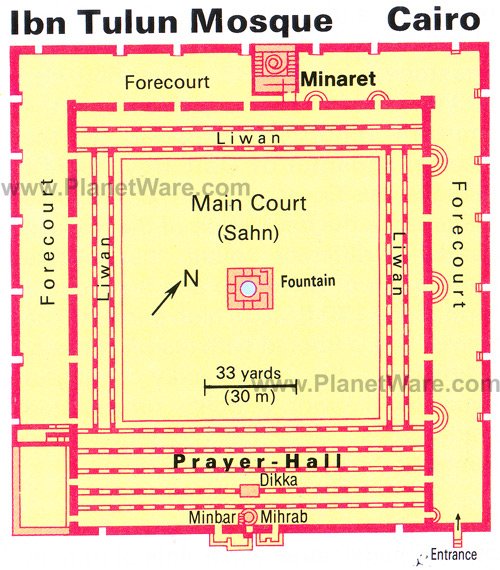
The entire complex of the Mosque of Ibn Tulun is surrounded by a wall and covers more than 6 acres. With an area of 26,318 sq m, the mosque itself is the third largest in the world.

The arches of the courtyard galleries are decorated with beautifully carved stucco, the first time this medium was used in Cairo.

The minaret, the only one of its kind in Egypt, is modeled after the minarets of Samarra, with a spiral staircase around the outside. Andalusian influence can also be seen in the horseshoe arches of the minaret windows and elsewhere - this was brought to Egypt by Muslim refugees who were driven out of Spain by the Reconquista .

The mosque has been restored several times. The first known restoration was in 1177 under orders of the Fatimid wazir Badr al-Jamālī, who left a second inscription slab on the mosque, which is noted for containing the Shī'ī version of the shahada, adding the phrase "And Ali is the wali of God" after acknowledging the oneness of God and the prophethood of Muhammad. Sultan Lajīn's restoration of 1296 added several improvements. The mosque was most recently restored by the Egyptian Supreme Council of Antiquities in 2004.

During the medieval period, several houses were built up against the outside walls of the mosque. Most were demolished in 1928 by the Committee for the Conservation of Arab Monuments, however, two of the oldest and best-preserved homes were left intact. The "house of the Cretan woman" (Beit al-Kritliyya) and the Beit Amna bint Salim, were originally two separate structures, but a bridge at the third floor level was added at some point, combining them into a single structure. The house, accessible through the outer walls of the mosque, is open to the public as the Gayer-Anderson Museum, named after the British general R.G. 'John' Gayer-Anderson, who lived there until 1942.

Ben Ezra Synagogue, Cairo , Egypt


The Ben Ezra Synagogue in Cairo is located behind the Hanging Church and was once a church itself.

The Ben Ezra Synagogue was originally a Christian church, which the Coptic Christians of Cairo had to sell to the Jews in 882 AD in order to pay the annual taxes imposed by the Muslim rulers of the time. The church was purchased by Abraham Ben Ezra, who came from Jerusalem during the reign of Ahmed Ibn Tulun, for 20,000 dinars.

The synagogue was a place of pilgrimage for North African Jews and the site of major festival celebrations. The famous medieval rabbi Moses Maimonides worshipped at Ben Ezra synagogue when he lived in Cairo.

The Monastery and Church of St. George (GREEK ORTHODOX) in Coptic Cairo , Egypt

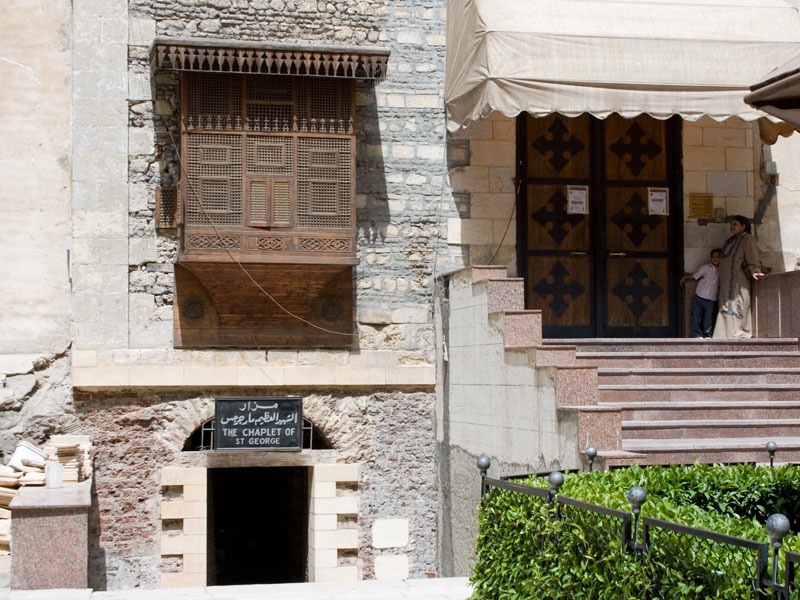
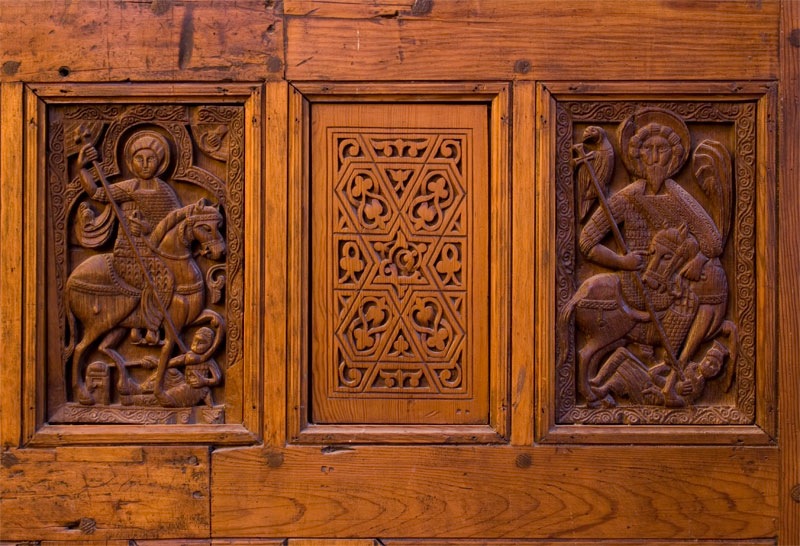
The image of St George as a Roman soldier mounted on a fine Arabian horse and spearing a dragon is a familiar one throughout Old Cairo, where there are two facilities dedicated to him. Throughout the Christian East, Saint George is undoubtedly the most popular warrior-saint, and in the Coptic churches of Cairo there are now more than twenty relics of the equestrian saint.
The Coptic biography of Saint George does not mention his flight with and victory over the dragon. Hence, scholars believe that around the fourteenth century this theme was a transferal from the biography of St. Theodore Stratelates to Saint George, though it is also possible that the Copts adopted this tale from the Western Christians.


The origin of he monastery of St. George (Deir al-Banat), located in Old Cairo, is obscure, but it is believed that the foundation of the structure dates from the seventh or eighth century. Today, the monastery is actually home to between thirty and forty religious women.

St. George Convent in old Cairo , Egypt

Old Cairo comprises six ancient churches, a Jewish Synagogue which was previously a Coptic church named after the angel Gabriel, the Coptic Museum and our convent, St. George.


These are the words spoken by our Lord Jesus Christ to St. George before his martyrdom. From the manuscript of St. George kept in St. George’s Convent in Old Cairo:

“I swear by myself, my beloved George, that as there was no one borne of woman greater than John the Baptist, also no martyr resembles you. You will have no counterpart among them. I made your name spread in my kingdom and gave it grace and made it a port of safety for all mankind. Whoever, in distress, calls on your name, either man or woman, I will quickly answer and give them their heart’s request.”

Abu Sarga church , Cairo , Egypt

Saints Sergius and Bacchus Church
 (ABU SARGA )


Abu Sarga is the oldest church in Egypt dating back to the 5th century A.D. The church owes its fame to having been constructed upon the crypt of the Holy Family where they stayed for three weeks during their sojourn in Egypt.

According to a biblical narration by evangelist Matthew (Chapter 2), Virgin Mary, Joseph and the baby Jesus fled from Palestine to Egypt out of fear from the persecution of the Jewish King Herod the Great. The Holy Family traveled as far as Assiut (“Deir el Muharraq”) and on their way back home spent some weeks in Old Cairo.

Abu Sarga is dedicated to the two Saints Sergius and Bacchus who served as soldiers in the Roman Army. They were faithful followers of the Lord Jesus and refused to worship the Roman gods. For their Christian belief, Sergius and Bacchus eventually suffered martyrdom in Syria in 296 during the reign of the Roman Emperor Maximinus. Their relics are partly kept in Abu Sarga and others are buried in Syria.

From the 9th to the 12th century, significant patriarchs were elected and several bishops consecrated in Abu Sarga until the 11th century. Although the church was restored several times (11th and 17th century, the last restoration was undertaken in 2000), it still preserves its Medieval charm.


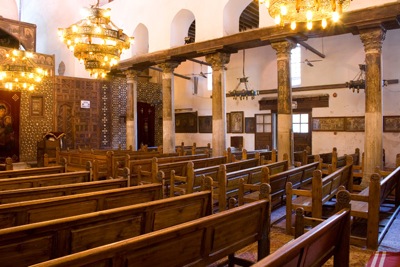
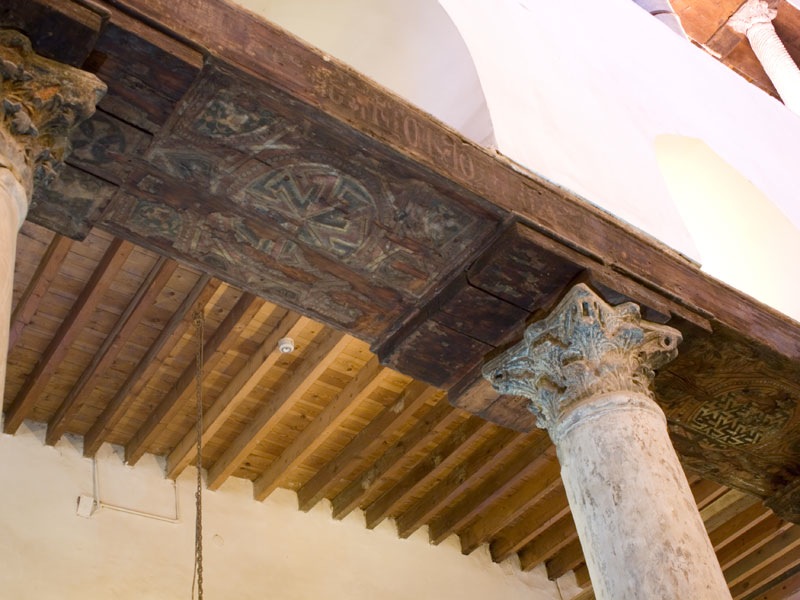
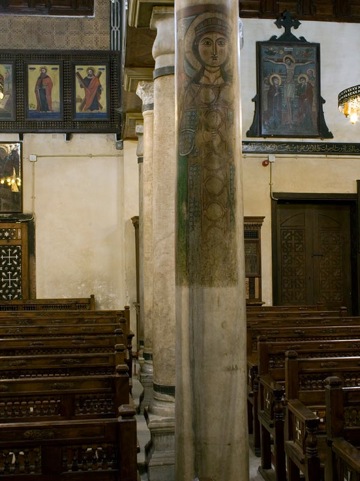
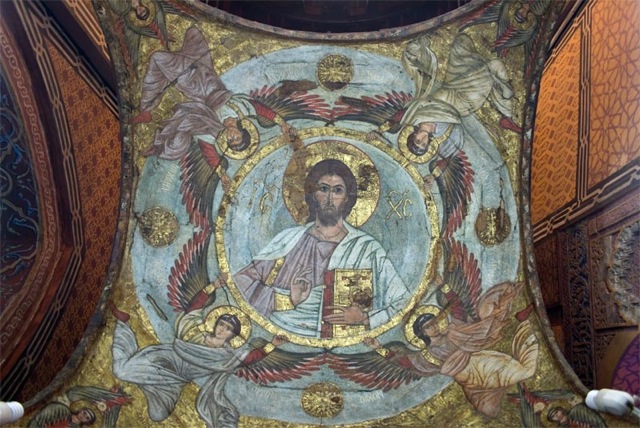
Abu Sarga is based on a basilican structure with a nave and two side aisles. The west end of the church is occupied by a return aisle. Twelve columns are set between the nave and the aisles, eleven of which are made of white marble and only one is of red granite. Some of the marble columns show clear traces of figures most likely representing saints. Corinthian capitals originating from older buildings are placed between the column shafts and the wooden architraves. On the east side of the church, a tripartite sanctuary is separated from the congregation hall by an impressive wooden screen which is beautifully decorated with ebony and ivory and whose oldest part dates back to the 13th century. Exceptional icons with various scenes from the life of Christ, Virgin Mary and diverse saints embellish the walls of Abu Sarga. Inside its main sancturary a wooden canopy supported by four pillars is placed above the altar and painted with biblical scenes, among them are Jesus Pantocrator and Archangel Gabriel appearing to Virgin Mary. The apse behind the altar is richly decorated with strips of marble and mosaics. A clerical seat is incorporated into the apse and can be reached by seven steps.

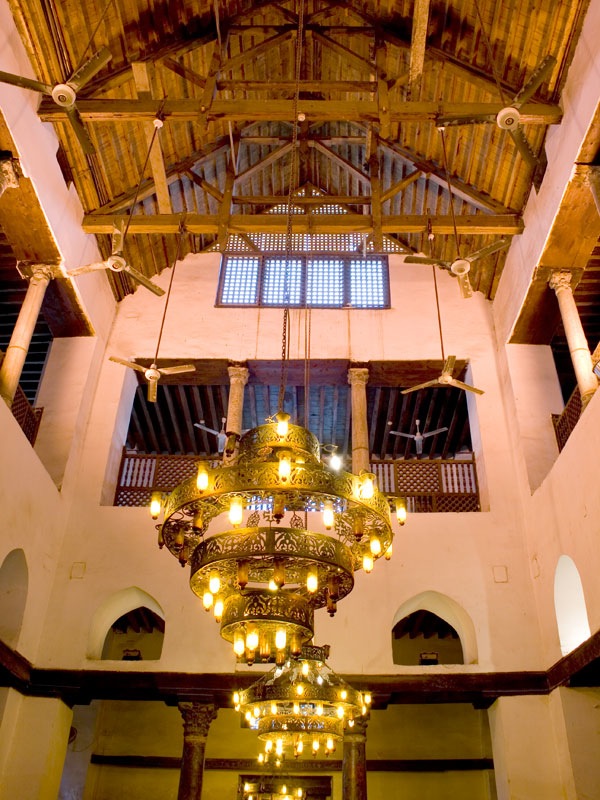
Abu Sarga once kept Egypt’s oldest altar which was transferred to the Coptic Museum. The roof is one of the most interesting features of the church and said to have been constructed in the shape of Noah’s ark. On the northwest side of the church is a baptistry. The marble ambon is a modern copy of the one in the neighbouring church of St. Barbara. Parts of the original wooden pulpit were brought to the Coptic Museum, and also to the British Museum in London. Above the side and return aisles is a gallery with two chapels (one dedicated to Sergius and Bacchus, the other to Ibraham, Isaac and Jacob) that are used for private service and during the fasting of Easter.


Photos


The roof of Abu Sarga

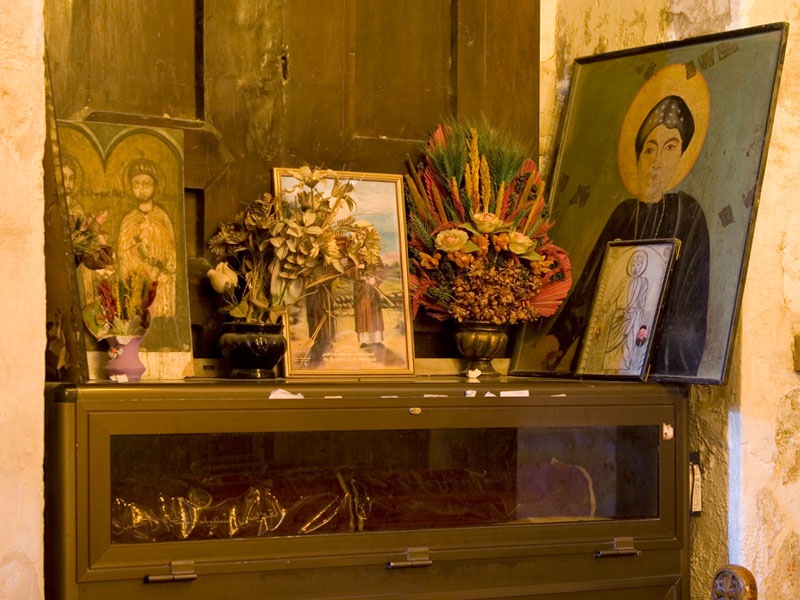
The relics of St. Sergius and St. Bacchus


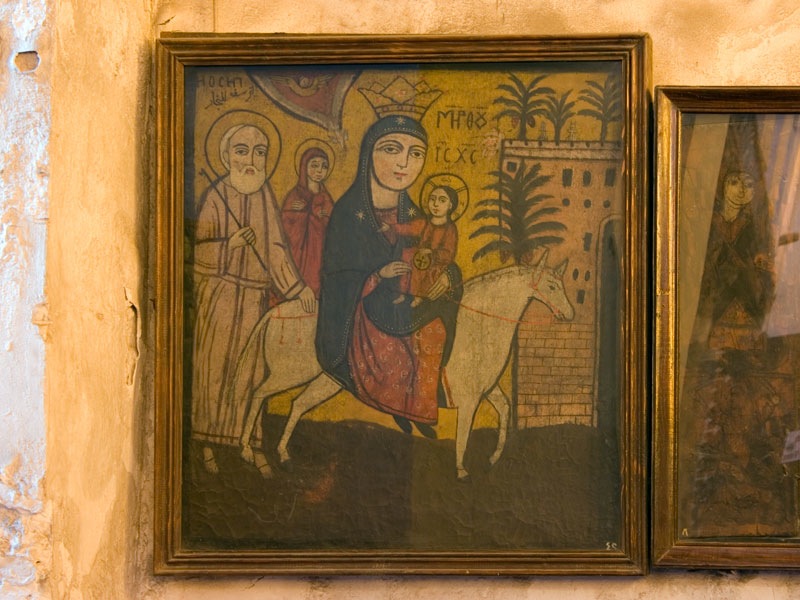
Icon showing the Flight of the Holy Family into Egypt


Reliefs showing equestrian saints

Hanging Church, Cairo , Egypt

Hanging Church


The Hanging Church is also referred to as the Suspended Church or Al-Moallaqa. It is called the Hanging Church because it was built on the southern gate of the Roman Fortress. Logs of palm trees and layers of stones were constructed above the ruins of the Roman fortress to be used as a fundament. The Hanging Church is a unique church and has a wooden roof in the shape of Noah’s ark. From the 7th century to the 13th century, the Hanging Church served as the residence of the Coptic Patriarch. Al-Moallaqa has witnessed important elections and religious ceremonies.


The famous miracle of moving the Moqattam Mountain is closely related to al-Moallaqa. Al-Mu’izz, a Fatimid khaliph, asked Patriarch Abraham (975-978), the 62nd Patriarch, to prove the truth of a verse in the Bible. Al-Mu’izz asked Patriarch Abraham to move the Moqattam Mountain in order to prove the words of the gospel “If you have faith the size of a mustard seed, you shall say to this mountain: Remove from hence to yonder place, and it shall remove“ (Matthew 17-20).


After three days of praying and fasting in front of the painting of the Virgin Mary depicted on a column in al-Moallaqa, the Virgin Mary appeared to Patriarch Abraham in a vision and told him what to do. The painting of the Virgin Mary exists in the church to this day. Al-Mu’izz was convinced of the truth of the Christian belief and allowed the Coptic Church certain privileges.
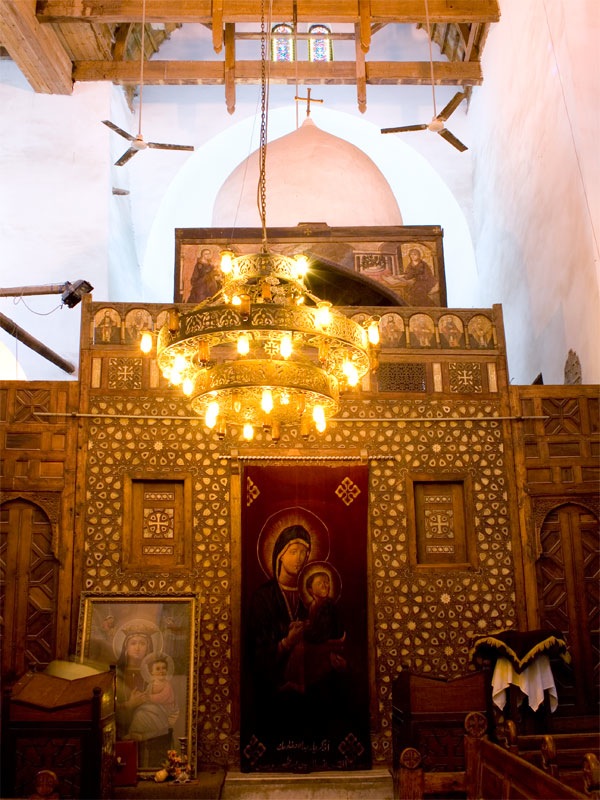
 There are three sanctuaries at the eastern side of the church, the one in the middle is dedicated to the Virgin Mary, the one to the left is named after St. George and the one to the right is named after John the Baptist. Inside the sanctuaries painted baldachins are placed above the altars.


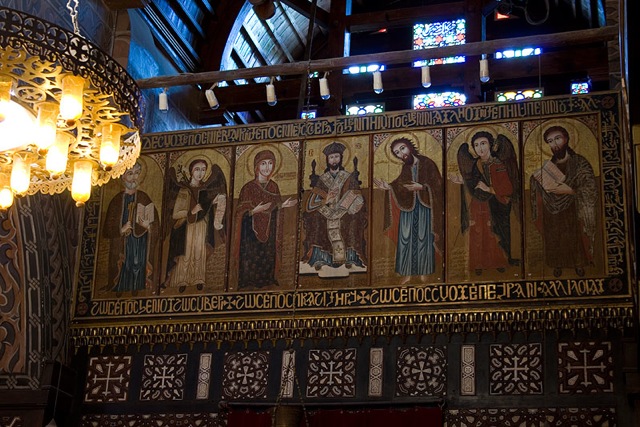
The wooden screen is a unique piece of art and richly decorated with geometric patterns and crosses in ebony and ivory.
 The wooden screen is crowned by precious icons, in the center the enthroned Jesus, on the left side the Virgin Mary, Archangel Gabriel and St. Peter, on the right side John the Baptist, Archangel Michael and St. Paul.


15 icons describe the life and torture of St. George, 7 icons give an insight into the life of John the Baptist.


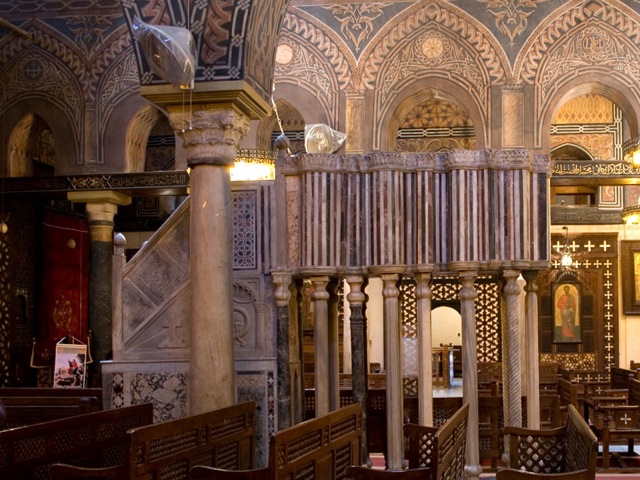
The impressive pulpit of the Hanging Church is from the 5th century and rests on 15 gracile columns. On each side of the pulpit a cross is depicted above three steps symbolizing the three days during which Jesus Christ was in his tomb and his resurrection.
 There is an icon of St. Mark on the southern wall of the main church (St. Mark is the first Patriarch of the Coptic Orthodox Church).

A total of 110 icons are kept in the Hanging Church, the oldest of which is the “Coptic Mona Lisa” dating back to the 8th century A.D. and representing Virgin Mary, Jesus Christ and John the Baptist. Numerous altar icons date back to the 18th century A.D.
There is a door at the south-eastern corner of the church leading to the oldest part of the building. This part has three sanctuaries at the eastern side. The one in the middle is called after St. Dimiana, the one to the left is named after St. Takla Hymanot (an Ethiopian saint), and the one to the right is named after St. Andrew.
Beside these sanctuaries is the baptistery.
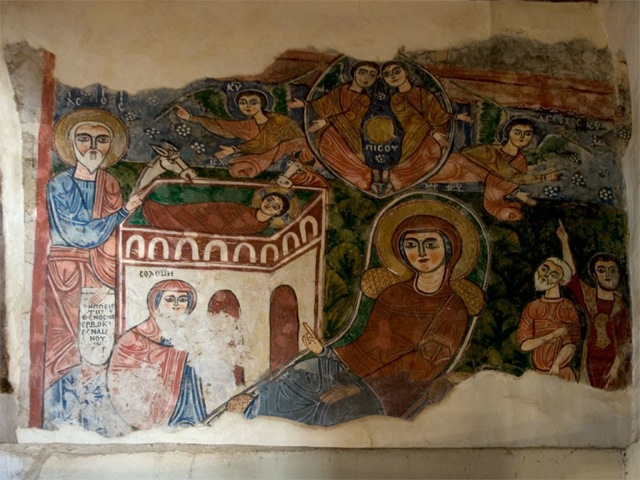
There is also a fresco on the eastern wall of the chapel showing the Nativity (the birth of Christ) and the mid wife Salome, next to it a second fresco of 24 men of the apocalypse. Furthermore, on the first floor a church dedicated to St. Mark.


Photos


Interior of the Hanging Church, with marble pulpit.


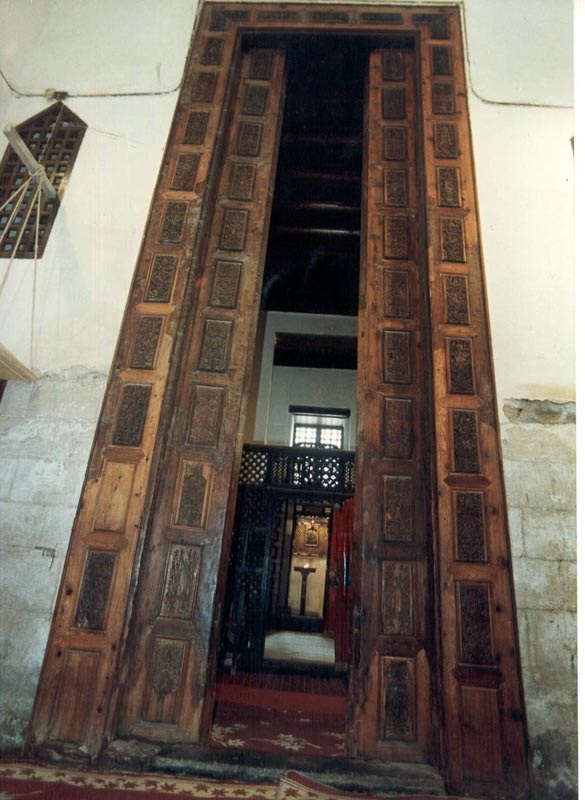
Detail of decoration over the door


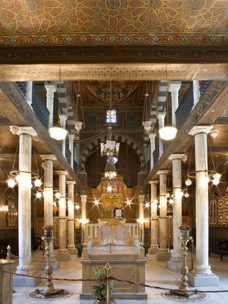
Beautifully decorated nave arcade.


Old Cairo ( Coptic Cairo ) , Egypt

Old Cairo (Coptic Cairo)


In 576 B.C.E ancient Egypt was invaded by Bokhas Nasr (King of Babel). In it was a fortification on the eastern shores of the Nile near the capital city of Memphis.

King Menes, the unifier of the two regions, built this fortification for protection. Although the building of the fortress was time consuming, it served its purpose for a period.
Trajan the Roman emperor, invaded Egypt and began to expand the property around the fortification. He extended roads and captured property around the area of the fortification.
For those who are unaware, Memphis was the capital of ancient Egypt at that time and remained famous until the 7th century C.E. But after some time its popularity declined and what remains now is a very small village named Mit Rahina which is next to a town called Badrashein in Giza.
When Alexander the Great conquered Egypt, he established the city of Alexandria and the fortress of Babel’s name changed from Babel to Babylon, according to the Greek of the time.
It is said, that the Roman Emperor Trajan (100 C.E.) entered the Egyptian territories and concentrated on this Babylon fortification. He then started to build many things within it and expanded the fortress around the area where we stand today.


The southern side (of this fortress) is the Hanging Church of the Virgin. Inside of the fortress, he started building grinding stations for grains, sites to extract juice from raisins and also living spaces.
The fortress is said to have a large wall with width of 2.5 meters and height of 20 meters.
After this, the city started developing outside the walls of the fortress. There was a very small cave in the city where people would go to seek refuge and live. So when the Holy family: the Virgin Mary, Joseph the Carpenter, baby Jesus and the midwife Salome (who accompanied them) fled from Palestine, they came to this cave. This is now underneath a church named Abu Sarga which is located next to the Church of the Martyr Saint Barbara.

After Christianity spread in the 4th century C.E. the Roman Empire adopted Christianity as the state religion, Roman authorities living around this area heard that the cave had been inhabited by the Virgin Mary. Hence, built a church on top of it named Abu Sarga for two martyrs belonging to the patriarch of Constantinople. It became a small church where the Romans prayed. This church is the oldest church (in Egypt) from the 4th century C.E.


When the Arabs arrived in the year 645 C.E. they conquered, looted the city and ousted the Roman authority. They then expanded the area and the Copts made use of the situation by building a church on two high towers in the fortress by the name of the Hanging Church of the Virgin. It is present today in Old Cairo.
Afterwards, Copts built other churches around the fortress and in an area that is a bit further away.
Within the walls of the fortress was a group of Roman Orthodox who built a church for themselves named Mar Girgis in the 10th century C.E. There was also a group of Jews who bought a church from the Orthodox Copts named for the Angel Michael next to the Church of Saint Barbara turning it into a synagogue named Ben Ezra.
When Amr Ibn Al-‘As expanded the Islamic empire into Egypt he established another town nearby named Fustat and in it a mosque named Amr Ibn Al-‘As. He built the foundation for a large city with streets, parks and luxurious buildings. History states that Coptic architects, engineers and craftsmen contributed their ideas.
In this period other churches were built in Fustat: The Church of Abu Sayfayn, the Church of the Virgin and the Church of his Holiness Father Shenouda. Furthermore, a convent for nuns and this location started to expand greatly.


Old Cairo was also where the patriarch from Alexandria would come to meet with the Arab governors and discuss the state of the churches in this area also known as the area of Babylon.


From the early times of Christianity there were three famous bishoprics in Egypt: Old Cairo or Babylon, Memphis (Capital of Ancient Egypt) and Ouseem.
The fortress has also produced Patriarchs and has been a center of learning for the patriarchic fathers. His Holiness Father Michael the 46th was said to be part of the Church Abu Sarga which is next to us now. There have been many famous bishops who emerged from here throughout history.
In the 13th century, Monk Boulus al-Boushi and also from among the famous priests is Ibn Khabar who was the pastor of the Hanging Church in the 14th century. Amongst the famous who were present was the monk Boutros Ibn T’abaan who lived here in the Hanging Church. His educators were the sons of ‘Asaal who were famous in Church history.
Also the liturgical cantor famous from this Church (the Hanging Church), Abu Shaakir Rahib Abu al Karam Boutros has been written about in famous books which exist in the libraries of ancient churches. We cannot forget the Saint Sam’aan Al-Kharaaz who is known from the Church of the Mountain Muqattam. Finally, Barsoum Al-Aria’an, whom was present in the Church of Abu Sayfayn.


During the days of Father Theodosios II (1298 C.E.) the chrism of the Hanging Church was completed and 25 bishops contributed to its making. Not to mention the famous architect S’aid Ibn Al-Kaatib Al Fara‛aani, the contemporary of Ahmed Ibn Tulun, who designed and made the nilometer in Rhoda and the designer of the mosque of Ibn Tulun, a masterpiece of architecture.
In the place where I stand, came many prominent people. It was the seat of the Patriarch after it left from Alexandria. The Hanging Church witnessed the naming of 11 Patriarchs and two in the Church of Abu Sayfayn.
Another piece of information is that this area is called the “wax castle”. It is so called because when Amr Ibn Al-‘As and his troops surrounded the fortress at night the Copts and the authority in Rhoda (as it is known today) would give signals with lights to each side and each would understand. Arab historians said that there was a castle with lit candles in it and this is how it acquired its name. This is just a quick historical insight of the significance of Old Cairo.


Currently, it is considered a visiting site for all those who desire to visit ancient places and you notice tourists coming daily to visit this place or that. Egyptians or anyone who is Christian feel they must come to these sites for the antiquities in them. It has become a ray of antiquities, monuments, and churches. It is a spark of light to anyone who wants to know about Christianity in Egypt because Christianity in Egypt stems from this location. Another significance of this location is the presence of the famous popular saints and it is present in their birthday celebrations and many people come to celebrate.


As for the Holy Family, when the divine command came to Joseph the carpenter to come to Egypt fleeing from the tyrant Herod in the year 3 C.E. Mary, Jesus and the midwife who witnessed the virgin birth came from Palestine and entered Sinai on the Northern side in the city of Farma (today between el-‘Areesh and Port Said). They then went down to the city of Tell al-Basta in Sharqiyya following Mostorod, Belbeis and Sammanoud, Qafr al-Sheikh and afterwards directly to Wadi el-Natrun in the western desert.


Something miraculous happened there and whoever visits Wadi el-Natrun knows of the spring of Mary. When the baby Jesus got thirsty God sprang for them very sweet water and this spring still exists and is surrounded by salt lakes. Of course it is a miracle that fresh water exists amongst these lakes. It is still known as Mary’s spring today.


After the western desert, they moved on to Matariyya, Ain Shams and then they came to Old Cairo. However, before they came to Old Cairo, they went to an alley called Zuweila in which now is a church called the Church of the Virgin. So they came to Old Cairo and the Virgin settled in the cave (below the church of Abu Sarga) that is now a visiting site for anyone who desires to smell the holiness and sweetness of the place blessed by the Virgin Mary, Joseph the Carpenter and the Baby Jesus.


There are many Churches in Fustat: Mercurius, the Convent of Father Shenouda, the Church of the Virgin, Abu Sayfayn, the Church of the Monk Father Shenouda, the Church of the Father of Babylon, the Church of Amir Tadros, the Church of the Angel Michael, the Church of Mar Mena from the days of his Holiness Father Kyrillos IV.


We made a CD that includes beautiful pictures of relics, icons, antiquities and churches. Also visible is the beautiful celebrations from the Church of Mar Girgis. There are examples how we pray, how we revere him, like we treat relics, how we go around (benediction) the church with the cross and devotional singing. Afterwards, we go to the convent of Mar Girgis and this is a representation of the similar fashion we celebrate of all the saints (for example Abu Sayfayn or Saint Barbara) and remember their martyrdom and their lives.
This is the conclusion to the discussion of Old Cairo.


THE HISTORY OF THE BABYLON FORTRESS


In “A Guide to the Ancient Coptic Churches of Cairo”, O.H.E. KHS-Burmester records significant historical information about the fortress area. According to him, Ptolemy (121-151 A.D.), in his book “Geography”, mentions a town named Babylon which existed from Pharaonic times on part of a site of what is now included in Cairo.
A canal ran through this town connecting the Nile with the Red Sea. Roman Emperor Trajan (98-117 A.D.) reopened this canal and also enlarged and equipped a fortress which was located at the southern end of the town. The fortress, known as the “Castle of Babylon”, or “Castle of Egypt” (Khemi), was further enlarged by Emperor Arcadius (395-408 A.D.). There was a fluvial port at this location where ships could anchor. In 335 A.D., the Roman Emperor altered shipping routes from Alexandria to the Babylon fortress. The area of Old Cairo was the first nucleus of present-day Cairo.


It is not known exactly when this city became a bishopric but it must have been before the first half of the 5th century as a certain Cyrus, Bishop of Babylon, was present at the Council of Ephesus held in 449 A.D.
At the time of the Arab conquest of Egypt, Babylon seemed to have been a large city extending northwards as far as Tendounias (‘Um Dunain’), the present district of al-Azbakiah, where there was a fortified outpost. The Arab general ‛Amr Ibn al-‘As captured this outpost and occupied the city as far as the Castle of Egypt, to which he laid siege. On April 9th, 641 A.D. this castle, which the Arabs named “Qasr ash-Sham’a (wax castle) surrendered. After the Arab conquest of Egypt, the name Babylon was more commonly used to denote the district immediately around the Castle of Egypt or Qasr ash-Sham’a. Eventually this became a quarter inhabited mainly by Christians.
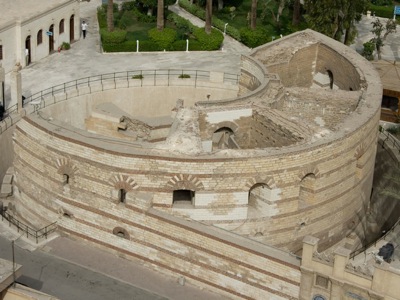
This fortress is similar to the Roman ones found in Europe and North Africa. At one time the course of the River Nile flowed under the fortress walls at the Roman Orthodox St. George’s Church. Roman methods of construction used a pattern of five blocks of limestone with three blocks of red bricks. The fortress, as well as older parts of the church, contain such patterns in their foundations.
The fortress’ towers are almost 10 meters high and 31 meters in diameter. The walls are almost 3 meters thick. The floor of the fortress is below the level of St. George Street by about 6 meters due to city construction over time.


Churches


Known in Arabic as al-Muallaqah ("The Suspended"), the Hanging Church is the most famous Coptic church in Cairo. The church is dedicated to the Virgin Mary and is thus also known as Sitt Mariam or St. Mary's Church.


The Hanging Church is named for its location above a gatehouse of the Roman fortress in Old Cairo; its nave is suspended over a passage. The church is approached by 29 steps; early travelers to Cairo dubbed it "the Staircase Church." Read More ...


Saints Sergius and Bacchus Church (Abo Serga )
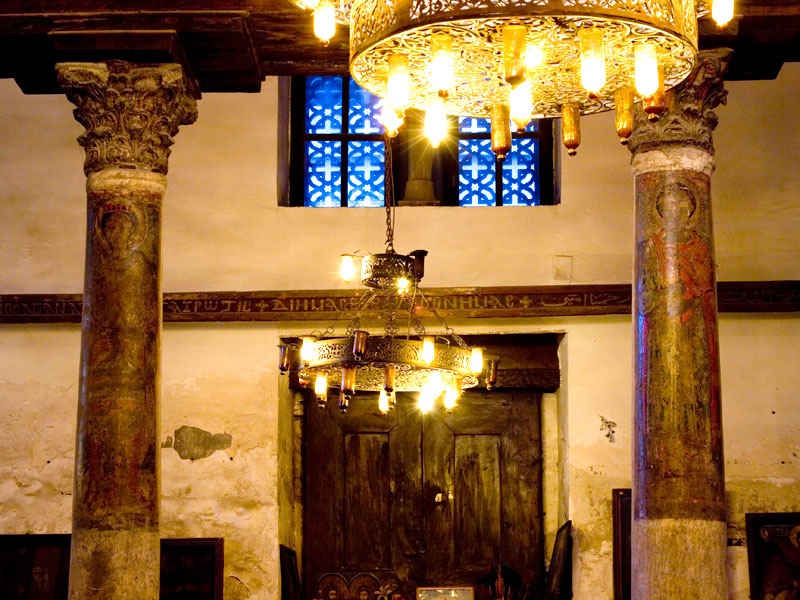

Saints Sergius and Bacchus Church is traditionally believed to have been built on the spot where the Holy Family, Joseph, Mary and the infant Jesus Christ, rested at the end of their journey into Egypt. They may have lived here while Joseph worked at the fortress.


The church is of significant historical importance, and in fact, it is where many patriarchs of the Coptic Church were elected. The first to be elected here was Patriarch Isaac (681-692) It is the episcopal church of Cairo, and it was the episcopal See of Masr (the district of Old Cairo) that replaced the former See of Babylon. Many bishops of the See were consecrated in the Church until the reign of Patriarch Christodulus (1047-1077). Read More ...


Saint Barbara Church


The church of St. Barbara is among the churches of Old Cairo of historic importance. It was originally dedicated to St. Cyrus and St. John who were worshipped for their healing powers. A small church at the northeastern corner of the building commemorates these two martyrs. Documents from the 13th century mention that the relics of St. Barbara were kept in this church. Many of its precious items, like two door panels, a wooden screen, an icon and Bible caskets were transferred to the nearby Coptic Museum. The basilican structure and tripartite sanctuary of the church closely resembles the one of Abu Sarga. The church of St. Barbara houses some of the rarest icons.


These are the words spoken by our Lord Jesus Christ to St. George before his martyrdom. From the manuscript of St. George kept in St. George’s Convent in Old Cairo:
“I swear by myself, my beloved George, that as there was no one borne of woman greater than John the Baptist, also no martyr resembles you. You will have no counterpart among them. I made your name spread in my kingdom and gave it grace and made it a port of safety for all mankind. Whoever, in distress, calls on your name, either man or woman, I will quickly answer and give them their heart’s request.”  Read More ...
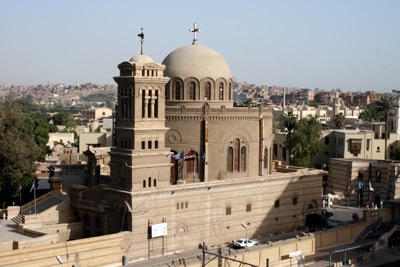


ST.GEORGE (GREEK ORTHODOX)


The Greek Orthodox Church of St. George was erected upon the northern tower of the Fortress of Babylon and echoes its round shape. The church can be reached through a flight of stairs and is crowned by an impressive dome. Tradition has it that St. George was kept in a prison close to the church and martyred there. The present building dates from the beginning of the 20th century. Read More ...


SYNAGOGUE


The Synagogue of Ben Ezra was originally a church. However, it needed to be sold to pay the annual taxes imposed on the church by the government in 882 A.D. The synagogue is named after Abraham Ben Ezra who bought the church for a sum of 20,000 dinars. The basilican structure with a nave and two aisles is still recognizable. The synagogue has become famous for its Geniza, an archive of ancient Jewish manuscripts, comprising thousands of rare manuscripts. Read More ...


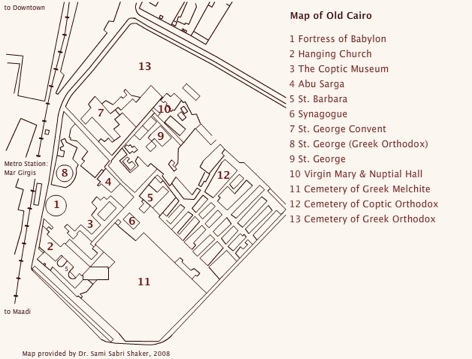
Map of Old Cairo