RSS
Showing posts with label CopTic. Show all posts

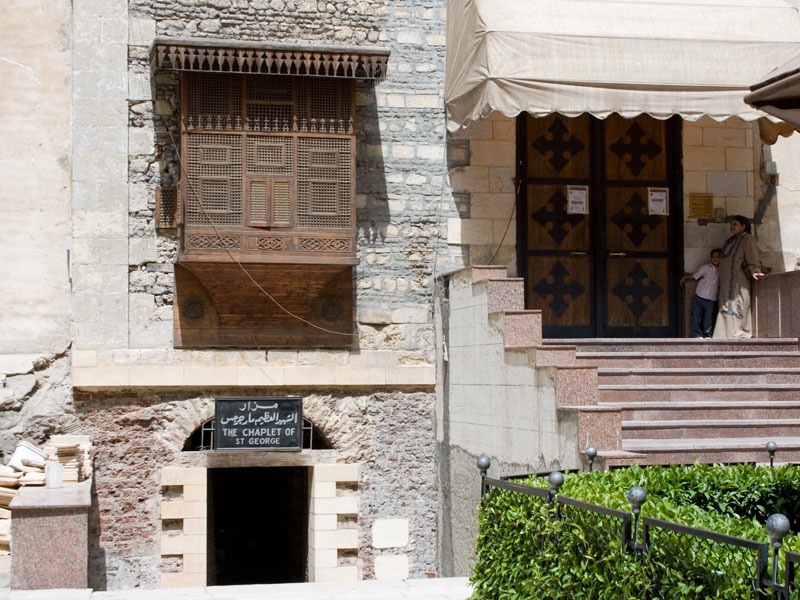
The Monastery and Church of St. George (GREEK ORTHODOX) in Coptic Cairo , Egypt

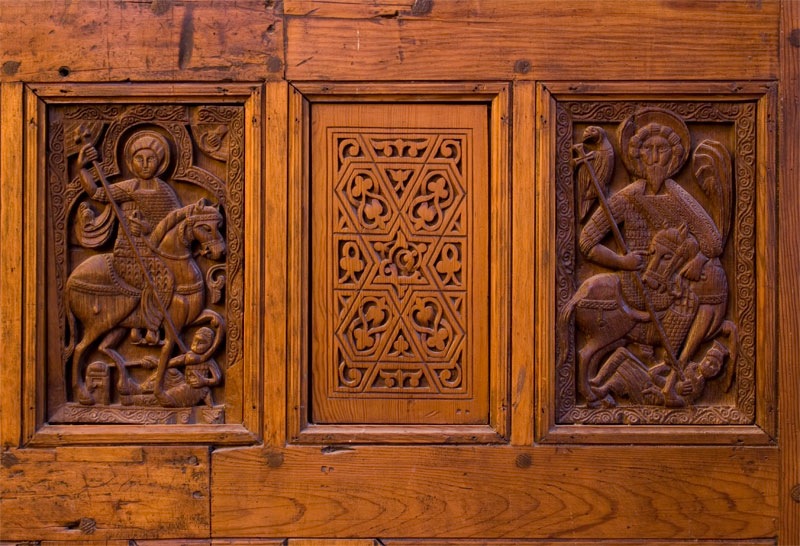
The image of St George as a Roman soldier mounted on a fine Arabian horse and spearing a dragon is a familiar one throughout Old Cairo, where there are two facilities dedicated to him. Throughout the Christian East, Saint George is undoubtedly the most popular warrior-saint, and in the Coptic churches of Cairo there are now more than twenty relics of the equestrian saint.
The Coptic biography of Saint George does not mention his flight with and victory over the dragon. Hence, scholars believe that around the fourteenth century this theme was a transferal from the biography of St. Theodore Stratelates to Saint George, though it is also possible that the Copts adopted this tale from the Western Christians.


The origin of he monastery of St. George (Deir al-Banat), located in Old Cairo, is obscure, but it is believed that the foundation of the structure dates from the seventh or eighth century. Today, the monastery is actually home to between thirty and forty religious women.

St. George Convent in old Cairo , Egypt

Old Cairo comprises six ancient churches, a Jewish Synagogue which was previously a Coptic church named after the angel Gabriel, the Coptic Museum and our convent, St. George.


These are the words spoken by our Lord Jesus Christ to St. George before his martyrdom. From the manuscript of St. George kept in St. George’s Convent in Old Cairo:

“I swear by myself, my beloved George, that as there was no one borne of woman greater than John the Baptist, also no martyr resembles you. You will have no counterpart among them. I made your name spread in my kingdom and gave it grace and made it a port of safety for all mankind. Whoever, in distress, calls on your name, either man or woman, I will quickly answer and give them their heart’s request.”

Saint Barbara Church in Coptic Cairo , Egypt


The Coptic Orthodox Church of St. Barbara (or Sitt Barbara) is one of the many famous Coptic Orthodox parishes that can be found in the district of Coptic Cairo. The building is located on the eastern part of the Babylon Fortress and is one of the oldest buildings in Cairo, dating back to the 5th or 6th century AD. However, like many other buildings of Coptic architecture, it was rebuilt several times, most notably by the end of the 11th Century.

Abu Sarga church , Cairo , Egypt

Saints Sergius and Bacchus Church
 (ABU SARGA )


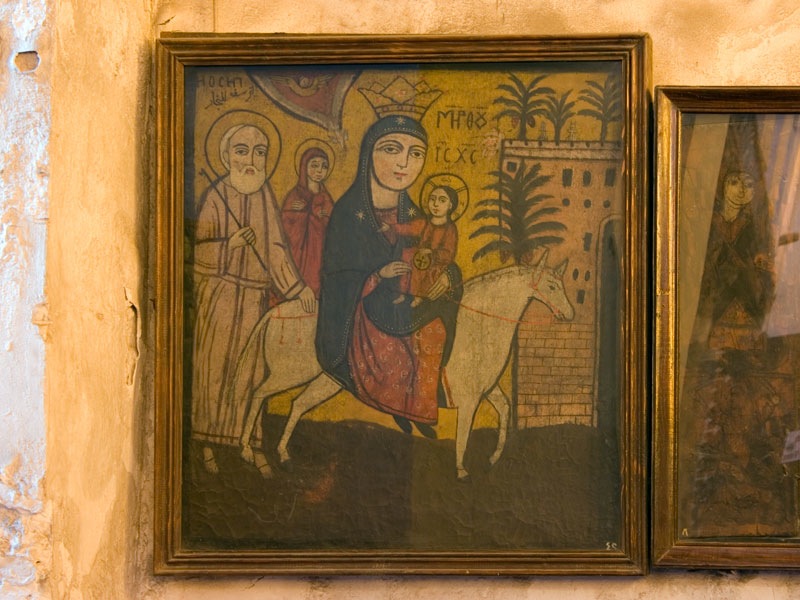
Abu Sarga is the oldest church in Egypt dating back to the 5th century A.D. The church owes its fame to having been constructed upon the crypt of the Holy Family where they stayed for three weeks during their sojourn in Egypt.

According to a biblical narration by evangelist Matthew (Chapter 2), Virgin Mary, Joseph and the baby Jesus fled from Palestine to Egypt out of fear from the persecution of the Jewish King Herod the Great. The Holy Family traveled as far as Assiut (“Deir el Muharraq”) and on their way back home spent some weeks in Old Cairo.

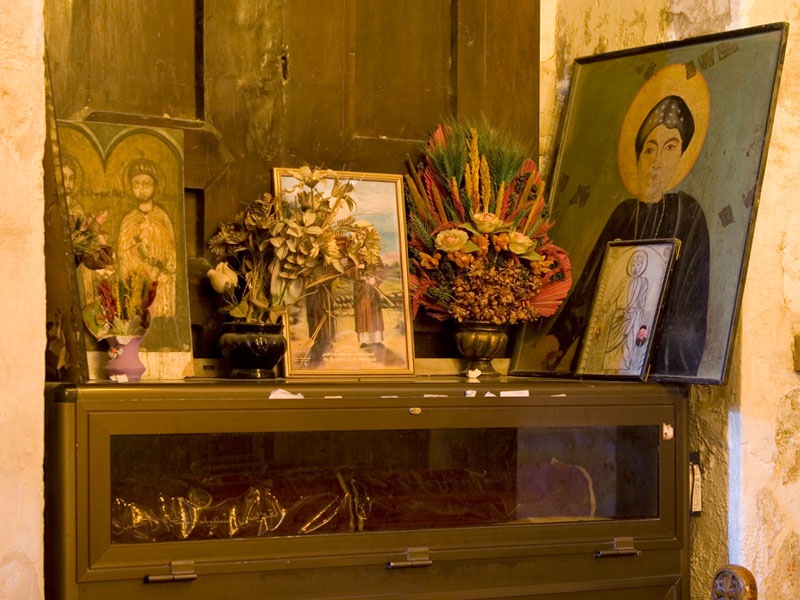
Abu Sarga is dedicated to the two Saints Sergius and Bacchus who served as soldiers in the Roman Army. They were faithful followers of the Lord Jesus and refused to worship the Roman gods. For their Christian belief, Sergius and Bacchus eventually suffered martyrdom in Syria in 296 during the reign of the Roman Emperor Maximinus. Their relics are partly kept in Abu Sarga and others are buried in Syria.

From the 9th to the 12th century, significant patriarchs were elected and several bishops consecrated in Abu Sarga until the 11th century. Although the church was restored several times (11th and 17th century, the last restoration was undertaken in 2000), it still preserves its Medieval charm.


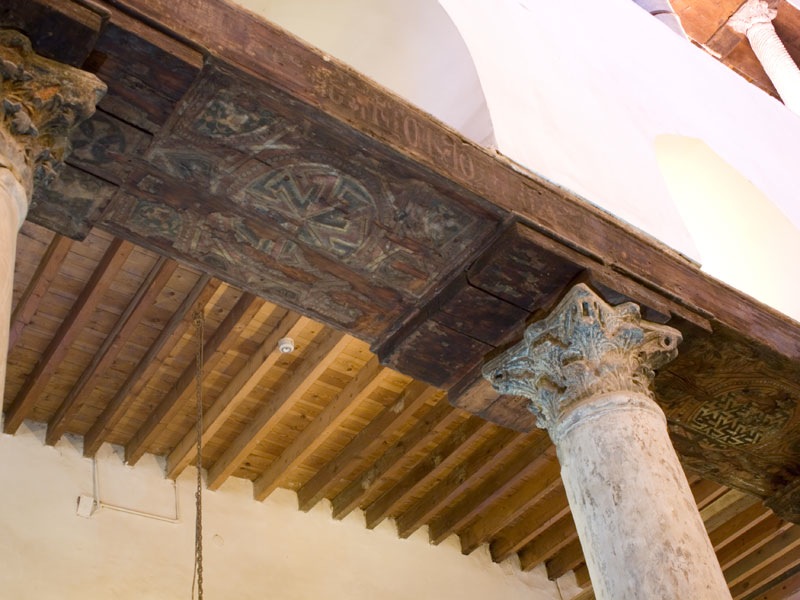
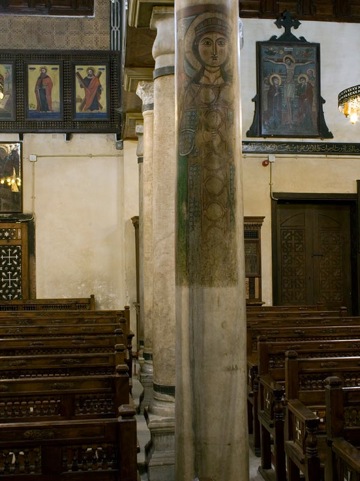
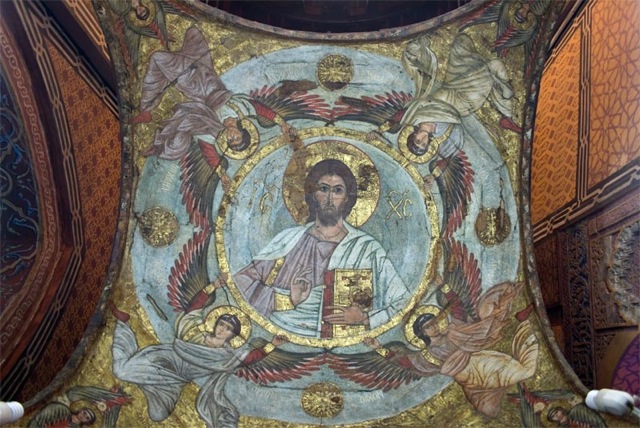
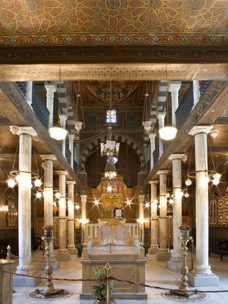
Abu Sarga is based on a basilican structure with a nave and two side aisles. The west end of the church is occupied by a return aisle. Twelve columns are set between the nave and the aisles, eleven of which are made of white marble and only one is of red granite. Some of the marble columns show clear traces of figures most likely representing saints. Corinthian capitals originating from older buildings are placed between the column shafts and the wooden architraves. On the east side of the church, a tripartite sanctuary is separated from the congregation hall by an impressive wooden screen which is beautifully decorated with ebony and ivory and whose oldest part dates back to the 13th century. Exceptional icons with various scenes from the life of Christ, Virgin Mary and diverse saints embellish the walls of Abu Sarga. Inside its main sancturary a wooden canopy supported by four pillars is placed above the altar and painted with biblical scenes, among them are Jesus Pantocrator and Archangel Gabriel appearing to Virgin Mary. The apse behind the altar is richly decorated with strips of marble and mosaics. A clerical seat is incorporated into the apse and can be reached by seven steps.

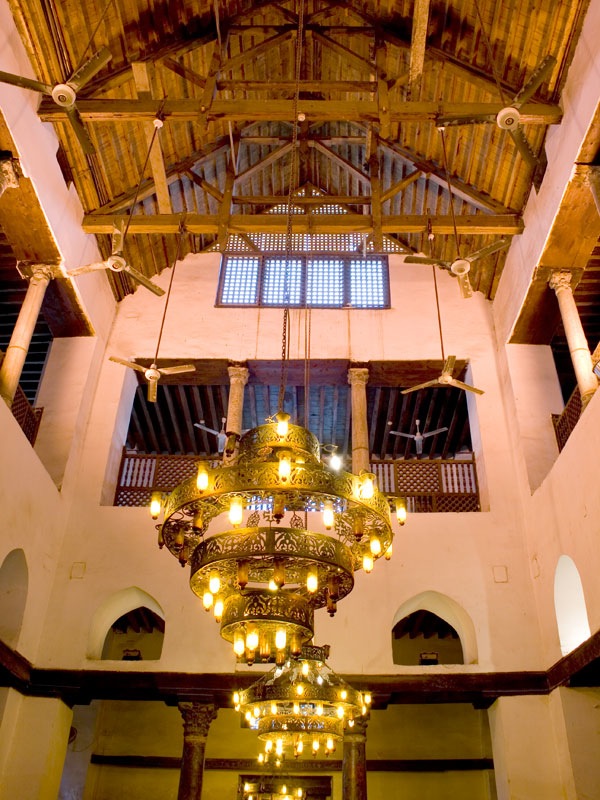
Abu Sarga once kept Egypt’s oldest altar which was transferred to the Coptic Museum. The roof is one of the most interesting features of the church and said to have been constructed in the shape of Noah’s ark. On the northwest side of the church is a baptistry. The marble ambon is a modern copy of the one in the neighbouring church of St. Barbara. Parts of the original wooden pulpit were brought to the Coptic Museum, and also to the British Museum in London. Above the side and return aisles is a gallery with two chapels (one dedicated to Sergius and Bacchus, the other to Ibraham, Isaac and Jacob) that are used for private service and during the fasting of Easter.


Photos


The roof of Abu Sarga

The relics of St. Sergius and St. Bacchus


Icon showing the Flight of the Holy Family into Egypt


Reliefs showing equestrian saints

Hanging Church, Cairo , Egypt

Hanging Church


The Hanging Church is also referred to as the Suspended Church or Al-Moallaqa. It is called the Hanging Church because it was built on the southern gate of the Roman Fortress. Logs of palm trees and layers of stones were constructed above the ruins of the Roman fortress to be used as a fundament. The Hanging Church is a unique church and has a wooden roof in the shape of Noah’s ark. From the 7th century to the 13th century, the Hanging Church served as the residence of the Coptic Patriarch. Al-Moallaqa has witnessed important elections and religious ceremonies.


The famous miracle of moving the Moqattam Mountain is closely related to al-Moallaqa. Al-Mu’izz, a Fatimid khaliph, asked Patriarch Abraham (975-978), the 62nd Patriarch, to prove the truth of a verse in the Bible. Al-Mu’izz asked Patriarch Abraham to move the Moqattam Mountain in order to prove the words of the gospel “If you have faith the size of a mustard seed, you shall say to this mountain: Remove from hence to yonder place, and it shall remove“ (Matthew 17-20).


After three days of praying and fasting in front of the painting of the Virgin Mary depicted on a column in al-Moallaqa, the Virgin Mary appeared to Patriarch Abraham in a vision and told him what to do. The painting of the Virgin Mary exists in the church to this day. Al-Mu’izz was convinced of the truth of the Christian belief and allowed the Coptic Church certain privileges.
 There are three sanctuaries at the eastern side of the church, the one in the middle is dedicated to the Virgin Mary, the one to the left is named after St. George and the one to the right is named after John the Baptist. Inside the sanctuaries painted baldachins are placed above the altars.


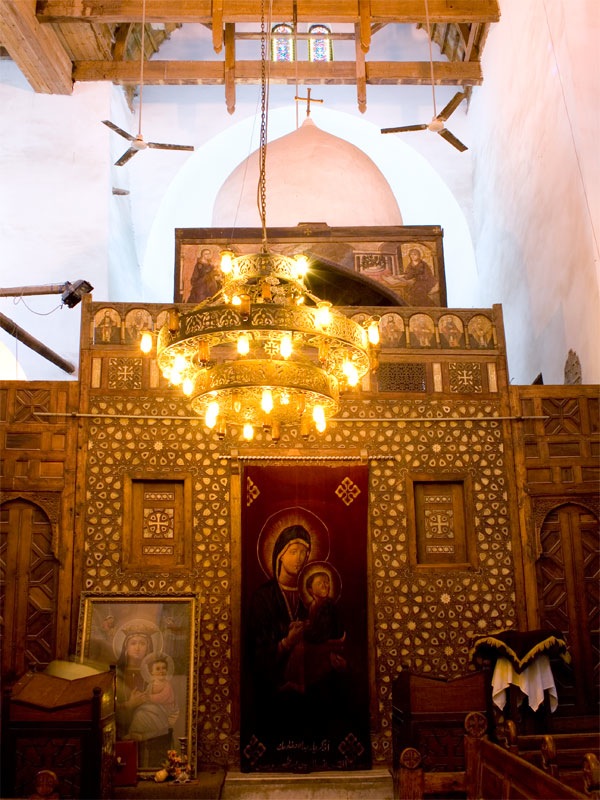
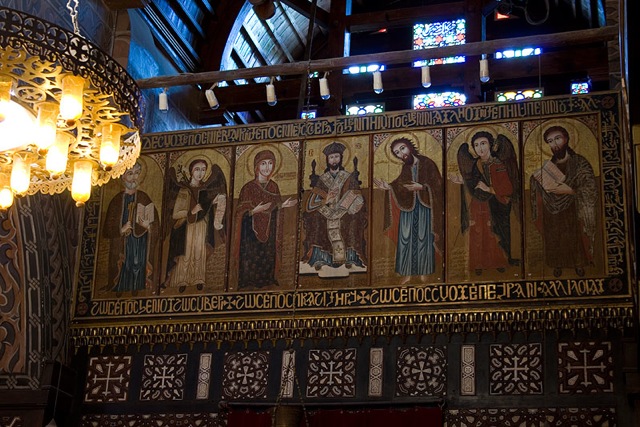
The wooden screen is a unique piece of art and richly decorated with geometric patterns and crosses in ebony and ivory.
 The wooden screen is crowned by precious icons, in the center the enthroned Jesus, on the left side the Virgin Mary, Archangel Gabriel and St. Peter, on the right side John the Baptist, Archangel Michael and St. Paul.


15 icons describe the life and torture of St. George, 7 icons give an insight into the life of John the Baptist.


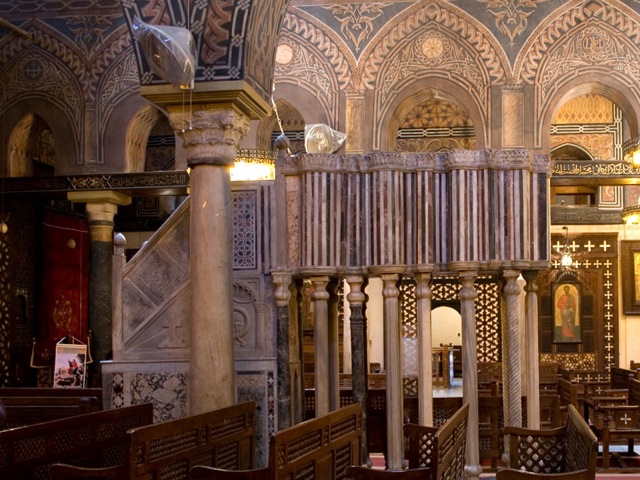
The impressive pulpit of the Hanging Church is from the 5th century and rests on 15 gracile columns. On each side of the pulpit a cross is depicted above three steps symbolizing the three days during which Jesus Christ was in his tomb and his resurrection.
 There is an icon of St. Mark on the southern wall of the main church (St. Mark is the first Patriarch of the Coptic Orthodox Church).

A total of 110 icons are kept in the Hanging Church, the oldest of which is the “Coptic Mona Lisa” dating back to the 8th century A.D. and representing Virgin Mary, Jesus Christ and John the Baptist. Numerous altar icons date back to the 18th century A.D.
There is a door at the south-eastern corner of the church leading to the oldest part of the building. This part has three sanctuaries at the eastern side. The one in the middle is called after St. Dimiana, the one to the left is named after St. Takla Hymanot (an Ethiopian saint), and the one to the right is named after St. Andrew.
Beside these sanctuaries is the baptistery.
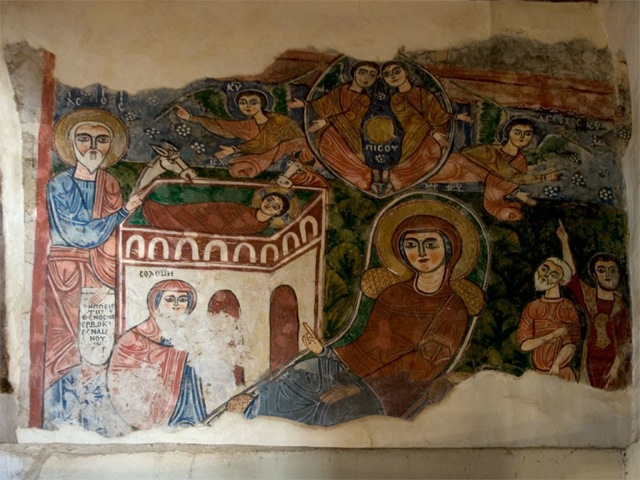
There is also a fresco on the eastern wall of the chapel showing the Nativity (the birth of Christ) and the mid wife Salome, next to it a second fresco of 24 men of the apocalypse. Furthermore, on the first floor a church dedicated to St. Mark.


Photos


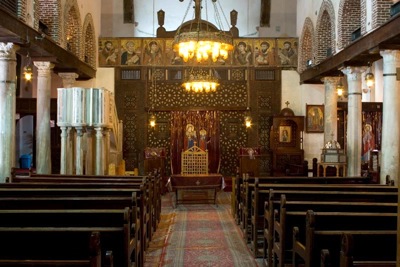
Interior of the Hanging Church, with marble pulpit.


Detail of decoration over the door


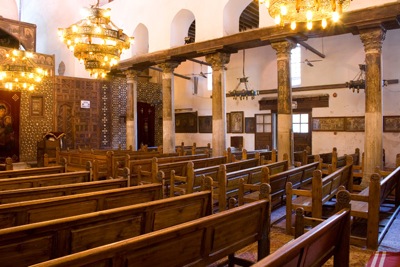
Beautifully decorated nave arcade.


Old Cairo ( Coptic Cairo ) , Egypt

Old Cairo (Coptic Cairo)


In 576 B.C.E ancient Egypt was invaded by Bokhas Nasr (King of Babel). In it was a fortification on the eastern shores of the Nile near the capital city of Memphis.

King Menes, the unifier of the two regions, built this fortification for protection. Although the building of the fortress was time consuming, it served its purpose for a period.
Trajan the Roman emperor, invaded Egypt and began to expand the property around the fortification. He extended roads and captured property around the area of the fortification.
For those who are unaware, Memphis was the capital of ancient Egypt at that time and remained famous until the 7th century C.E. But after some time its popularity declined and what remains now is a very small village named Mit Rahina which is next to a town called Badrashein in Giza.
When Alexander the Great conquered Egypt, he established the city of Alexandria and the fortress of Babel’s name changed from Babel to Babylon, according to the Greek of the time.
It is said, that the Roman Emperor Trajan (100 C.E.) entered the Egyptian territories and concentrated on this Babylon fortification. He then started to build many things within it and expanded the fortress around the area where we stand today.


The southern side (of this fortress) is the Hanging Church of the Virgin. Inside of the fortress, he started building grinding stations for grains, sites to extract juice from raisins and also living spaces.
The fortress is said to have a large wall with width of 2.5 meters and height of 20 meters.
After this, the city started developing outside the walls of the fortress. There was a very small cave in the city where people would go to seek refuge and live. So when the Holy family: the Virgin Mary, Joseph the Carpenter, baby Jesus and the midwife Salome (who accompanied them) fled from Palestine, they came to this cave. This is now underneath a church named Abu Sarga which is located next to the Church of the Martyr Saint Barbara.

After Christianity spread in the 4th century C.E. the Roman Empire adopted Christianity as the state religion, Roman authorities living around this area heard that the cave had been inhabited by the Virgin Mary. Hence, built a church on top of it named Abu Sarga for two martyrs belonging to the patriarch of Constantinople. It became a small church where the Romans prayed. This church is the oldest church (in Egypt) from the 4th century C.E.


When the Arabs arrived in the year 645 C.E. they conquered, looted the city and ousted the Roman authority. They then expanded the area and the Copts made use of the situation by building a church on two high towers in the fortress by the name of the Hanging Church of the Virgin. It is present today in Old Cairo.
Afterwards, Copts built other churches around the fortress and in an area that is a bit further away.
Within the walls of the fortress was a group of Roman Orthodox who built a church for themselves named Mar Girgis in the 10th century C.E. There was also a group of Jews who bought a church from the Orthodox Copts named for the Angel Michael next to the Church of Saint Barbara turning it into a synagogue named Ben Ezra.
When Amr Ibn Al-‘As expanded the Islamic empire into Egypt he established another town nearby named Fustat and in it a mosque named Amr Ibn Al-‘As. He built the foundation for a large city with streets, parks and luxurious buildings. History states that Coptic architects, engineers and craftsmen contributed their ideas.
In this period other churches were built in Fustat: The Church of Abu Sayfayn, the Church of the Virgin and the Church of his Holiness Father Shenouda. Furthermore, a convent for nuns and this location started to expand greatly.


Old Cairo was also where the patriarch from Alexandria would come to meet with the Arab governors and discuss the state of the churches in this area also known as the area of Babylon.


From the early times of Christianity there were three famous bishoprics in Egypt: Old Cairo or Babylon, Memphis (Capital of Ancient Egypt) and Ouseem.
The fortress has also produced Patriarchs and has been a center of learning for the patriarchic fathers. His Holiness Father Michael the 46th was said to be part of the Church Abu Sarga which is next to us now. There have been many famous bishops who emerged from here throughout history.
In the 13th century, Monk Boulus al-Boushi and also from among the famous priests is Ibn Khabar who was the pastor of the Hanging Church in the 14th century. Amongst the famous who were present was the monk Boutros Ibn T’abaan who lived here in the Hanging Church. His educators were the sons of ‘Asaal who were famous in Church history.
Also the liturgical cantor famous from this Church (the Hanging Church), Abu Shaakir Rahib Abu al Karam Boutros has been written about in famous books which exist in the libraries of ancient churches. We cannot forget the Saint Sam’aan Al-Kharaaz who is known from the Church of the Mountain Muqattam. Finally, Barsoum Al-Aria’an, whom was present in the Church of Abu Sayfayn.


During the days of Father Theodosios II (1298 C.E.) the chrism of the Hanging Church was completed and 25 bishops contributed to its making. Not to mention the famous architect S’aid Ibn Al-Kaatib Al Fara‛aani, the contemporary of Ahmed Ibn Tulun, who designed and made the nilometer in Rhoda and the designer of the mosque of Ibn Tulun, a masterpiece of architecture.
In the place where I stand, came many prominent people. It was the seat of the Patriarch after it left from Alexandria. The Hanging Church witnessed the naming of 11 Patriarchs and two in the Church of Abu Sayfayn.
Another piece of information is that this area is called the “wax castle”. It is so called because when Amr Ibn Al-‘As and his troops surrounded the fortress at night the Copts and the authority in Rhoda (as it is known today) would give signals with lights to each side and each would understand. Arab historians said that there was a castle with lit candles in it and this is how it acquired its name. This is just a quick historical insight of the significance of Old Cairo.


Currently, it is considered a visiting site for all those who desire to visit ancient places and you notice tourists coming daily to visit this place or that. Egyptians or anyone who is Christian feel they must come to these sites for the antiquities in them. It has become a ray of antiquities, monuments, and churches. It is a spark of light to anyone who wants to know about Christianity in Egypt because Christianity in Egypt stems from this location. Another significance of this location is the presence of the famous popular saints and it is present in their birthday celebrations and many people come to celebrate.


As for the Holy Family, when the divine command came to Joseph the carpenter to come to Egypt fleeing from the tyrant Herod in the year 3 C.E. Mary, Jesus and the midwife who witnessed the virgin birth came from Palestine and entered Sinai on the Northern side in the city of Farma (today between el-‘Areesh and Port Said). They then went down to the city of Tell al-Basta in Sharqiyya following Mostorod, Belbeis and Sammanoud, Qafr al-Sheikh and afterwards directly to Wadi el-Natrun in the western desert.


Something miraculous happened there and whoever visits Wadi el-Natrun knows of the spring of Mary. When the baby Jesus got thirsty God sprang for them very sweet water and this spring still exists and is surrounded by salt lakes. Of course it is a miracle that fresh water exists amongst these lakes. It is still known as Mary’s spring today.


After the western desert, they moved on to Matariyya, Ain Shams and then they came to Old Cairo. However, before they came to Old Cairo, they went to an alley called Zuweila in which now is a church called the Church of the Virgin. So they came to Old Cairo and the Virgin settled in the cave (below the church of Abu Sarga) that is now a visiting site for anyone who desires to smell the holiness and sweetness of the place blessed by the Virgin Mary, Joseph the Carpenter and the Baby Jesus.


There are many Churches in Fustat: Mercurius, the Convent of Father Shenouda, the Church of the Virgin, Abu Sayfayn, the Church of the Monk Father Shenouda, the Church of the Father of Babylon, the Church of Amir Tadros, the Church of the Angel Michael, the Church of Mar Mena from the days of his Holiness Father Kyrillos IV.


We made a CD that includes beautiful pictures of relics, icons, antiquities and churches. Also visible is the beautiful celebrations from the Church of Mar Girgis. There are examples how we pray, how we revere him, like we treat relics, how we go around (benediction) the church with the cross and devotional singing. Afterwards, we go to the convent of Mar Girgis and this is a representation of the similar fashion we celebrate of all the saints (for example Abu Sayfayn or Saint Barbara) and remember their martyrdom and their lives.
This is the conclusion to the discussion of Old Cairo.


THE HISTORY OF THE BABYLON FORTRESS


In “A Guide to the Ancient Coptic Churches of Cairo”, O.H.E. KHS-Burmester records significant historical information about the fortress area. According to him, Ptolemy (121-151 A.D.), in his book “Geography”, mentions a town named Babylon which existed from Pharaonic times on part of a site of what is now included in Cairo.
A canal ran through this town connecting the Nile with the Red Sea. Roman Emperor Trajan (98-117 A.D.) reopened this canal and also enlarged and equipped a fortress which was located at the southern end of the town. The fortress, known as the “Castle of Babylon”, or “Castle of Egypt” (Khemi), was further enlarged by Emperor Arcadius (395-408 A.D.). There was a fluvial port at this location where ships could anchor. In 335 A.D., the Roman Emperor altered shipping routes from Alexandria to the Babylon fortress. The area of Old Cairo was the first nucleus of present-day Cairo.


It is not known exactly when this city became a bishopric but it must have been before the first half of the 5th century as a certain Cyrus, Bishop of Babylon, was present at the Council of Ephesus held in 449 A.D.
At the time of the Arab conquest of Egypt, Babylon seemed to have been a large city extending northwards as far as Tendounias (‘Um Dunain’), the present district of al-Azbakiah, where there was a fortified outpost. The Arab general ‛Amr Ibn al-‘As captured this outpost and occupied the city as far as the Castle of Egypt, to which he laid siege. On April 9th, 641 A.D. this castle, which the Arabs named “Qasr ash-Sham’a (wax castle) surrendered. After the Arab conquest of Egypt, the name Babylon was more commonly used to denote the district immediately around the Castle of Egypt or Qasr ash-Sham’a. Eventually this became a quarter inhabited mainly by Christians.
This fortress is similar to the Roman ones found in Europe and North Africa. At one time the course of the River Nile flowed under the fortress walls at the Roman Orthodox St. George’s Church. Roman methods of construction used a pattern of five blocks of limestone with three blocks of red bricks. The fortress, as well as older parts of the church, contain such patterns in their foundations.
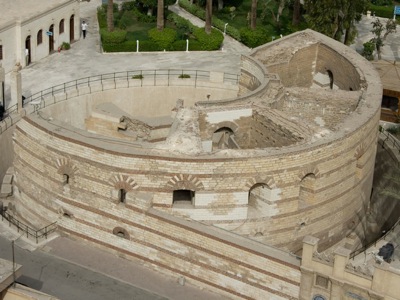
The fortress’ towers are almost 10 meters high and 31 meters in diameter. The walls are almost 3 meters thick. The floor of the fortress is below the level of St. George Street by about 6 meters due to city construction over time.


Churches


Known in Arabic as al-Muallaqah ("The Suspended"), the Hanging Church is the most famous Coptic church in Cairo. The church is dedicated to the Virgin Mary and is thus also known as Sitt Mariam or St. Mary's Church.


The Hanging Church is named for its location above a gatehouse of the Roman fortress in Old Cairo; its nave is suspended over a passage. The church is approached by 29 steps; early travelers to Cairo dubbed it "the Staircase Church." Read More ...


Saints Sergius and Bacchus Church (Abo Serga )
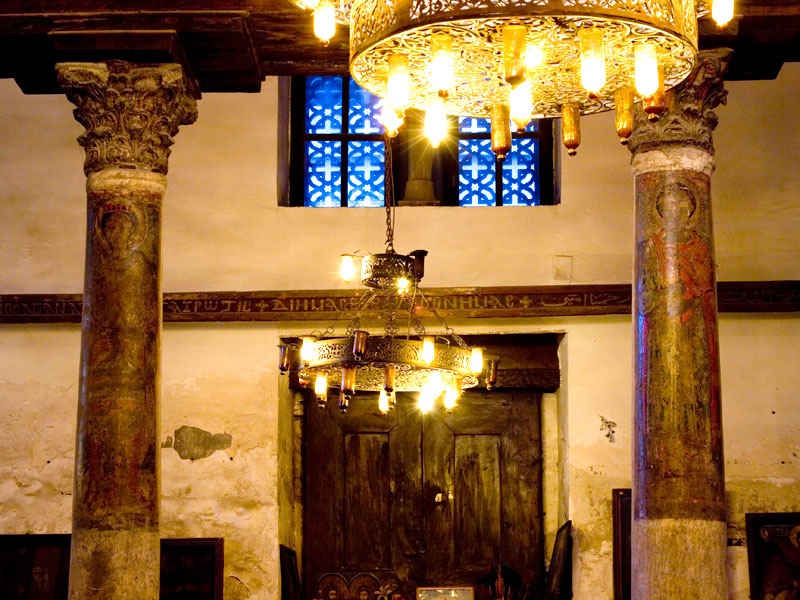

Saints Sergius and Bacchus Church is traditionally believed to have been built on the spot where the Holy Family, Joseph, Mary and the infant Jesus Christ, rested at the end of their journey into Egypt. They may have lived here while Joseph worked at the fortress.


The church is of significant historical importance, and in fact, it is where many patriarchs of the Coptic Church were elected. The first to be elected here was Patriarch Isaac (681-692) It is the episcopal church of Cairo, and it was the episcopal See of Masr (the district of Old Cairo) that replaced the former See of Babylon. Many bishops of the See were consecrated in the Church until the reign of Patriarch Christodulus (1047-1077). Read More ...


Saint Barbara Church


The church of St. Barbara is among the churches of Old Cairo of historic importance. It was originally dedicated to St. Cyrus and St. John who were worshipped for their healing powers. A small church at the northeastern corner of the building commemorates these two martyrs. Documents from the 13th century mention that the relics of St. Barbara were kept in this church. Many of its precious items, like two door panels, a wooden screen, an icon and Bible caskets were transferred to the nearby Coptic Museum. The basilican structure and tripartite sanctuary of the church closely resembles the one of Abu Sarga. The church of St. Barbara houses some of the rarest icons.


These are the words spoken by our Lord Jesus Christ to St. George before his martyrdom. From the manuscript of St. George kept in St. George’s Convent in Old Cairo:
“I swear by myself, my beloved George, that as there was no one borne of woman greater than John the Baptist, also no martyr resembles you. You will have no counterpart among them. I made your name spread in my kingdom and gave it grace and made it a port of safety for all mankind. Whoever, in distress, calls on your name, either man or woman, I will quickly answer and give them their heart’s request.”  Read More ...
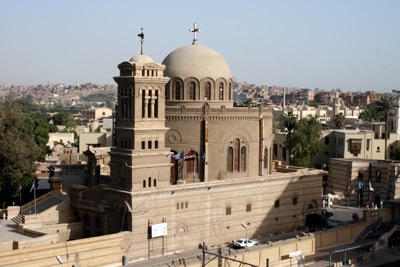


ST.GEORGE (GREEK ORTHODOX)


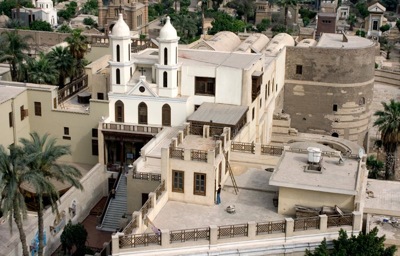
The Greek Orthodox Church of St. George was erected upon the northern tower of the Fortress of Babylon and echoes its round shape. The church can be reached through a flight of stairs and is crowned by an impressive dome. Tradition has it that St. George was kept in a prison close to the church and martyred there. The present building dates from the beginning of the 20th century. Read More ...


SYNAGOGUE


The Synagogue of Ben Ezra was originally a church. However, it needed to be sold to pay the annual taxes imposed on the church by the government in 882 A.D. The synagogue is named after Abraham Ben Ezra who bought the church for a sum of 20,000 dinars. The basilican structure with a nave and two aisles is still recognizable. The synagogue has become famous for its Geniza, an archive of ancient Jewish manuscripts, comprising thousands of rare manuscripts. Read More ...


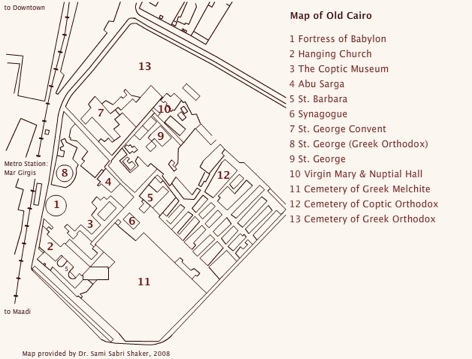
Map of Old Cairo


The Coptic Museum in Cairo , Egypt

The Coptic Museum


The Coptic Museum in Cairo has been closed for some time for remodeling, but we are now celebrating its recent reopening, a welcome addition to Old Coptic Cairo. It is located in the heart of Coptic Cairo.

Christianity has a long history in Egypt, and there continues to be a significant population of Christians in Egypt today. Besides the truly Egyptian heritage of Coptic Christians, there are also Roman Catholics, as well as a number of Protestant sects. Christianity spread in Egypt during the 2nd century in Egypt, just after and indeed during the Roman pagan period, and it became the dominant religion in Egypt up until the Arab invasion in 641 AD.

Christian art, specific to the Coptics of Egypt, began to emerge around 300 AD. Though Christianity marked the end of the Pharaonic period in Egypt, and even though many traditions from that more ancient religion were carried over to become a part of not only the Christian faith in Egypt, but later even the Islamic faith, the art in form, style and content was very different from those earlier times.

We can identify principally three reasons that Egyptian art made such a radical change. First of all, art was no longer such an imperial effort of the ruling elite, formalized according to the dictates of a small minority. The second reason is that Christianity delivered a very different message than that of the former pagan religion, and the art indeed changed to deliver this message. Finally, the social origins of Coptic art is perhaps best characterized as folk art. While there were certainly some professional artists centered mostly in Alexandria, at first, most of the Christian artists were local folk who did the best with their undertaking as they could.

One interesting difference is that, by around 300 AD, three-dimensional art seems to have almost completely disappeared in Egypt, at least in the form of statuary. The last free standing sculptures in Egypt were those of Roman emperors, but the sculptures of the early Coptics, irregardless of the material used, were engaged, consisting more of an exaggerated raised relief. They usually faced the viewer directly, but they could also be half turned to one side. Over the centuries, these figures became flatter and more like conventional relief.
This shift from three-dimensional representations probably also affected two-dimensional art. In traditional Pharaonic art, figures were most frequently represented in a combination of profile and frontal views, but Coptic art abandoned this old formula and turned the figure around to face the viewer. It is worth noting that much of this sculpture was originally coated with painted plaster which would have shown many details that are now gone.

The most striking stylistic feature of Coptic figurative representation are the exaggerated rounded or oval eyes, under relatively thick eyebrows, and the contrapposto position (the weight of the body thrown onto one leg). Garments are often depicted with details of pleats and folds. The figures range from tall and slim to the short and thickset. Facial expressions usually span a narrow divide between non-committal to somber.

Yet, some influences remained. As Christianity arose, the old indigenous religion and that of the Greek educated ruling elite had not yet vanished.
Even though the style and form may have changed, Coptic Christian art featured a substantial amount of episodes from Greek religious thought, particularly the sculpture of Ahnas and textiles. The use of such motifs in a Christian context is somewhat puzzling, and we can really give no definitive solution to this, other than the overlap which occurred between these two cultures. In fact, it would certainly seem that a number of pagan themes were de-paganized and recycled to convey messages in keeping with Christian values. It has been argued that such themes themselves may have become a symbol of the triumph of Christianity over paganism.

The largest collection of Coptic Christian artifacts in the world, with some 16,000 pieces, belongs to the Coptic Museum in Cairo. Indeed, this museum represents more than simply a collection of ancient Christian art. Perhaps no more so than for its western Christian visitors, it embodies the very instant when the old, pagan world collided with that of their modern Christian world. It is an eye-opener for many, as it documents this not altogether gradual but very significant moment in time.

The first exhibition of Coptic art was held in Cairo during the nineteenth century in the "Salle Copte" at the Boulaq Museum. In 1908 Marcus Simaika Pasha founded the Coptic Museum on behalf of the Coptic Church. He chose for its location a unique place in Old Coptic Cairo, within the walls of the great Fortress of Babylon and surrounded by Cairo's oldest churches. With the support of Patriarch Cyril V he purchased artifacts from churches, monasteries, houses and private collections.


The old, original wing of the museum is in itself a fine piece of architecture consisting of a series of large rooms, roofed over with ancient decorated wood and containing beautiful mashrabiya. Its walls are overlaid with fine slabs of marble, arches a and tiles. In 1931 the Egyptian government recognized the significance of the Coptic Museum and made it a state institution. Afterwards, the greater part of the magnificent Coptic collection in the Egyptian Antiquities Museum was transferred to the Coptic Museum in 1939.
Then, in 1947 a large New Wing with a style complimentary to the old one was opened It too had carved wooden ceilings as well as picturesque fountains. It was later renovated with modern methods of exhibition and reopened on March 8th, 1984. Only recently was it once again renovated.

The "General Catalogue of the Coptic Museum", an ongoing international project, was initiated in 1986 to compile an current catalogue of all the objects in the museum. The Museum's rich collection is arranged mostly according to media.


Stonework


The provenance of most Coptic textiles and minor works of art is usually unknown, but Coptic sculpture and wall paintings are better documented. The most important sites for these items are Abu Mina, Saqqara, Ahnas, Oxyrhynchos, Antinoe and Bawit. Nevertheless, many of the excavations that unearthed these items took place in the 19th century, and were therefore not as well documented as one might suppose. Furthermore, the re-use of older architectural elements, often from pharaonic monuments, makes exact dating of Coptic sculpture difficult.

The majority of the monuments from which this collection was taken are in ruins. Mostly, architectural carvings, separate from their original context, including niches, pediments, friezes, lintels, consoles, columns and capitals, make of this exhibit. All of it was originally painted.

During the 4th and 5th centuries pagan mythological scenes, such as Orpheus and Eurydice or Leda and the swan, continued to be depicted alongside Christian themes. The cross, supported by erotes or angels, is a central element of Coptic sculpture. Often, scenes of the christological cycle appear isolated, such as the Madonna and Child and the Holy Virgin with the saints. Scenes from the Old Testament are also frequently incorporated into sculpture. Examples include Daniel flanked by two lions or the Three Hebrews in the Fiery Furnace. On the other hand, at the monastic sites of Bawit and Saqqara there was a clear tendency towards geometric and floral architectural sculpture with niches and friezes. Also, aspects of daily life, such as the grape harvest or fishing in the marshes, are not uncommon in Coptic sculpture.

Corinthian, basket and composite capitals were developed in a rich variety of abstract styles, especially discernable in the basket capitals of the 6th century.

The Stelae of Terenuthis (Kom Abu-Bellou)

Basically a part of the Stonework collection, these objects are mostly limestone gravestones (or stelae) discovered at Terenuthis which was for the most part a Graeco-Roman pagan cemetery. Almost all of them fall into one of two categories. The first type have the figure depicted frontally and often flanked by two small jackal-like dogs representing Anubis, the lord of the necropolis, or Horus, the life-giving solar god as well as Anubis. A second type depicts a figure reclining on a kline and holding a cup in the right hand. Many of the stelae are framed by an architectural structure of two columns carrying a triangular Greek pediment. These items are essential to the understanding and evaluation of the origins of Coptic art.

Ivory and Bone Carvings
Alexandria was one of the principal markets for African ivory during the Greek Period of Egyptian history. By the Roman Period, Persia became more important for Indian Ivory, while bone, a much cheaper substitute, began to be widely used as well. The Coptic Museum's collection of ivory and bone carvings consists of wooden bridal caskets of engraved bone or ivory plaques with naked human figures and nymphs, pyxides, bone figurines representing schematized female figures with cylindrical bodies; bone spindle whorls; pots and other objects of daily use. Included in this collection is the famous 6th century ivory comb depicting the Raising of Lazarus and the Healing of the Blind.

Metalwork


Not surprisingly perhaps, considering Egypt's historic quest for rare metals, the Coptic museums collection of metalwork is a rich one, containing gold and silver, but also copper, bronze and iron. These pieces represent some of the oldest objects in the museum, dating from the 3rd to the 19th century. They come from monasteries, churches and towns, and may therefore be either religious objects or items intended for everyday use. The main group includes crosses, censers, lamps, bells, bible caskets, chandeliers, church and monastery keys, liturgical implements. Other items include household utensils, such as bowls, dishes, pans and cooking bots, while for women there are kohl boxes, necklaces, earrings and bracelets, and there are also medical instruments, weights and measures and agricultural implements. Many of these items are well executed and adorned using different techniques.

The majority of these objects are difficult to date, though a few, such as the famous Luxor silver treasure of Abraham, bishop of Hermonthis (c. 600) and some of the Bible caskets, which are inscribed with dates, or objects found with coins, can be securely dated.

Woodwork
Egypt lacks good quality wood for the most part, which has always made it a valuable commodity. During the Pharaonic Period find wood, and especially ebony, was imported from the south (Kush, or Nubia and Punt) and cedar from Lebanon and Syria. During the Roman and Byzantine Periods, Egypt was much less prosperous then in much of the Pharaonic Period. Therefore, one might expect that fine imported wood should have been used mainly in Alexandria, but it is known, however, that indigenous wood such as tamarisk, acacia, sycamore, lebbakh, jujube and willow were widely and skillfully used by Coptic carpenters, and that imported woods, such as box, cedar, ebony liquidambar, olive and pine were employed for fine and important works. The main centers of Coptic carpentry were Babylon (a section of Old Coptic Cairo), Antinoe, Bawit and Akhmin.
Many churches and monasteries were once adorned with elaborate sculptures in wood, consisting of lintels, doors, panels and friezes, decorated with saints, Nile themes, floral and animal ornaments, geometric patterns and scenes taken from the Old and New Testaments. Smaller items made of wood for daily life include toilette equipment, combs, caskets, toys spindles, stamp seals and musical instruments.


Woodwork, particularly screens, doors and panels of the 10th through the 14th centuries, reflects clearly the influence of Islamic Art.
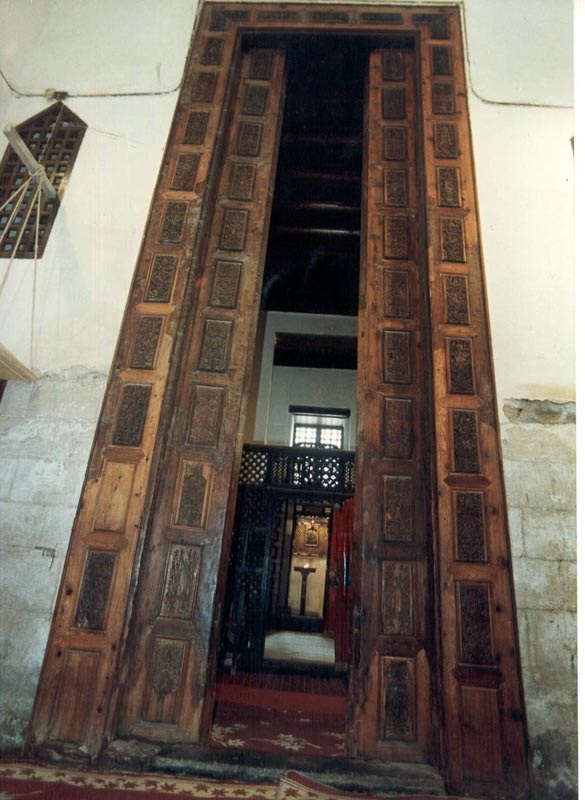
The Coptic Museum houses three of the most important wood artifacts from the churches of Old Coptic Cairo. They are the door of the Church of Saint Barbara, the altar of the Church of Saints Sergius and Bacchus and the lintel from Al-Mo'allqa. They are very valuable for the study of Coptic sculpture during the period between the 4th and 6th centuries.

Glass

Glass has, since its first use in Egypt, been a very important and prosperous industry in Egypt. Unlike wood, sand, lime and soda, the raw materials of glass, were abundantly available in Egypt. In the 1st Century BC, it was discovered that molten glass could be blown through a hollow tube, thus allowing it to be produced in quantities that made it available to the general public. Blown, engraved, opaque and millefiori glass have all been produced by Egyptian glassmakers. Literary sources revel that liturgical vessels in the early Coptic church were most frequently made of glass, rather than gold or silver.

The Coptic Museum maintains a small collection containing glass vessels, goblets, pots, candle holders, toilette bottles and lamps, mostly of opaque glass.

Ceramics and Terracotta

Pottery is a cheap material and a huge quantity of various wares have been unearthed in Egypt. The study of Coptic pottery in particular has progressed remarkably in the last three decades are so thanks to carefully recorded excavations at many sites. Of particular interest are those of Abu Mina, Kellia, Athribis, Naqlun, Antinoe and Esna.


Most are made of brown, red, orange, yellow, cream and pink clay, some coarse and some polished. The Coptic Museum houses a fine collection of pottery made for everyday use, including huge storage jars, amphorae and wine jars, cooking pots, spouted vessels, vases, jugs, bowls and dishes. There are also terracotta ampullae, lamps and figurines.

Many of the pieces on display have intricate designs and motifs of which animals are the most common, including hares, doves, fish, lions, gazelles and fantastic animals. Many human figures, mostly in the form of busts, were also painted on pottery, similar to some of those from Bawit.

Characteristic of Coptic terracotta are frog-shaped lamps and ampullae depicting Saint Menas standing between two kneeling camels. The Coptic Museum also exhibits some examples of Islamic glazed pottery from Al-Fustat.


Wall paintings

Almost all Coptic wall painting is monastic. They were never intended to be great works of art, but some of them, and in particular those at Bawit and Saqqara from the 6th and 7th century, show a relatively high standard. These murals were applied to mud-brick walls which had been plastered and white-washed. The only technique used for Coptic murals was tempera.


Those paintings from the Monastery of Saint Apollo at Bawit (in the Bahariya Oasis), dating between the 6th and 8th centuries, consist of figural scenes including episodes from the Old Testament, representations of Christ the Pantokrator and the Holy Virgin and Child, often flanked by apostles, figures of monks and saints, medallions depicting the virtues, floral and geometric dadoes, and even hunting scenes.

The murals of the Monastery of Saint Jeremias at Saqqara are more or less similar to those of Bawit. The figures are strictly frontal and usually distinctly separated from each other. The presence of Byzantine influence can be seen, but the wall paintings are nevertheless not without originality in some themes as well as in style.


Icons


Most of the icons in the Coptic Museum were acquired from Cairo's oldest churches. The majority of them are relatively modern, dating from the 18th and 19th centuries. They are, nevertheless, interesting for their themes, including scenes from the Old and New Testaments, the Holy Virgin, saints and martyrs, and especially soldier saints. Coptic churches, both ancient and modern, are always adorned with icons since they are used in the liturgy of the Coptic Church. Indeed, the older churches are perhaps a better venue for seeing the older icons than the Coptic Museum.

However, several icons stand out. One, for example, dating to the 18th century, depicts Ahrakas and Oghani, who wear masks in the forms of dog heads. They pear towards a fruit tree. Another depicts the Virgin and Child. He raises a crown with a cross, and is flanked by Saint Peter and Saint Paul. Another touching icon represents the Virgin Mary holding the Christ child, and dates to the eighteenth century. Many others depict various saints.

Epigraphy and Manuscripts.


The manuscripts and documents of the museum date from the 4th through the 19th centuries, and are written in Greek, Coptic, Syriac, Old Nubian, Arabic and Ethiopian. Some are even bilingual, written in both Coptic and Arabic. They are printed on Papyrus, parchment, paper, bone and wood tablets, as well as pottery and limestone. Some are complete manuscripts, while others are fragments, mostly biblical, hagiographical and liturgical.

Clearly, the documents and ostraca provide valuable insights into the ecclesiastical, social, economic and legal aspects of different periods. Some of the illuminated manuscripts are remarkable. The Coptic Psalter from the 4th or 5th century, recently discovered, is now considered the oldest complete biblical text possessed by Egypt. The Coptic Gnostic codices from the 4th century could be considered one of the most valuable collections of papyri in the world.

Textiles


Coptic textiles are well known and almost certainly the most characteristic product of Coptic art. Coptic textiles is used to describe a huge number of textiles, tens of thousands in fact, found in Egypt and dating from the Roman, Byzantine and Islamic periods. Most Coptic textiles were unearthed from burials, but those excavated during the 19the and early 20th century at such sites as Akhmim and Antinoe were little more than treasure hunts rather than systematic scientific undertakings. There were also illegal digs that saw thousands of Coptic textiles reach the antiquities market, and there are more than a few of these that ended up outside Egypt. It is therefore very difficult to date most of them with precision. In most cases, the style of the textile is all that can be used to date them.

 
Among the various textiles preserved are complete garments, particularly tunics, parts of garments such as tunic ornaments (vertical tapestry bands or clavi, roundels or orbiculae, and panels), curtains and hangings, cushions, covers, napkins and parts of shrouds. The major types of fiber used in making these textiles were linen and wool, although cotton was occasionally used, and even silk, mostly imported, played an important role in the industry. Dyes were usually derived from plant, animal and mineral sources, the principal ones being alkanet (red); woad, indigo, kermes and suntberry (blue); saffron, pomegranate and weld (yellow); leaves of the iris plant, berries of the buckthorn plant (green); and minerals such as iron (black). Purple dye was obtained from shellfish.


Coptic textiles are notable for the richness of their decorative motifs, including geometric patterns, human figures, birds, animals, fish, flora, mythological themes, Nile and marine scenes, episodes from the Old and New Testaments and crosses.
 Hence, Coptic textiles are much more than colorful pieces of cloth. They provide a rich source of information about the social classes, daily life, beliefs and customs of the people who wore and wove them.


Nubian Material


When the Aswan High Dam was constructed, an international effort was mounted to salvage the Nubian monuments that would be submerged once the construction of the Dam was completed. Included among these monuments were Christian structures dating between the 5th and the 14th or 15th centuries. The Coptic Museum now exhibits a number of frescoes from these churches, including ones from the Church of Abdallah Nirqi (10th century). Other items include Nubian Christian gravestones, pottery and textiles. Old Nubian and Coptic texts from Nubia are also on display.


Towards the end of the museum are a few of the most masterful pieces within the museum collection. These include the patriarchal throne build of bronze and copper, resting on four strong columns surmounted by crosses. A second piece is a wooden litter inlaid with bone and mother of pearl used to carry wealthy ladies in Jerusalem. It dates to the Ottoman period and is rich with decorations. The last item is a wooden box with ivory inlays. It was originally intended to store clerical vestments during the 17th through 19th centuries. It is adorned with very remarkable geometric decorations.

Opening Hours

9 am – 5 pm


Ticket office closes at 4 pm


Ramadan

9 am – 3 pm
Entrance Fees

Foreigners 40 EGP
Foreign Students 20 EGP
Egyptians 2 EGP
Egyptian Students 1 EGP
Please note that photography is not permitted unless you have written approval from the Supreme Council of Antquities
Address
Metro Station Mar Girgis
3 Sharia Mar Girgis
Old Cairo
Telephone
Director 23628766
Operator 23639742