RSS
Showing posts with label Luxor. Show all posts

Colossi of Memnon (memorial temple of Amenophis III)

The Colossi of Memnon (known to locals as el-Colossat, or es-Salamat) are two massive stone statues of Pharaoh Amenhotep III. For the past 3400 years (since 1350 BC) they have stood in the Theban necropolis, across the River Nile from the modern city of Luxor.

Description
he twin statues depict Amenhotep III (fl. 14th century BC) in a seated position, his hands resting on his knees and his gaze facing eastwards (actually SSE in modern bearings) towards the river. Two shorter figures are carved into the front throne alongside his legs: these are his wife Tiy and mother Mutemwiya. The side panels depict the Nile god Hapy.


The statues are made from blocks of quartzite sandstone which was stone quarried at el-Gabal el-Ahmar (near modern-day Cairo) and transported 420 miles overland to Thebes. (They are too heavy to have been transported upstream on the Nile.) The blocks used by later Roman engineers to reconstruct the eastern colossus may have come from Edfu (north of Aswan). Including the stone platforms on which they stand (about 4 meters themselves), the colossi reach a towering 18 metres (approx. 60 ft) in height and weigh an estimated 700 tons each.  The two figures are about 50 feet apart.

Both statues are quite damaged, with the features above the waist virtually unrecognizable. The western (or southern) statue is a single piece of stone, but the eastern (or northern) figure has a large extentive crack in the lower half and above the waist consists of 5 tiers of stone. These upper levels consist of a different type of sandstone, and are the result of a later (Roman Empire) reconstruction attempt. It is believed that originally the two statues were identical to each other, although inscriptions and minor art may have varied.

The original function of the Colossi was to stand guard at the entrance to Amenhotep's memorial temple (or mortuary temple): a massive cult centre built during the pharaoh's lifetime, where he was worshipped as a god-on-earth both before and after his departure from this world. In its day, this temple complex was the largest and most opulent in Egypt. Covering a total of 35 ha, even later rivals such as Ramesses II's Ramesseum or Ramesses III's Medinet Habu were unable to match it in area; even the Temple of Karnak, as it stood in Amenhotep's time, was smaller.
 
With the exception of the Colossi, however, very little remains today of Amenhotep's temple. Standing on the edge of the Nile floodplain, successive annual inundations gnawed away at the foundations – a famous 1840s lithograph by David Roberts shows the Colossi surrounded by water – and it was not unknown for later rulers to dismantle, purloin, and reuse portions of their predecessors' monuments.
 
Name
Memnon was a hero of the Trojan War, a King of Ethiopia who led his armies from Africa into Asia Minor to help defend the beleaguered city but was ultimately slain by Achilles. The name Memnon means "Ruler of the Dawn", and was probably applied to the colossi because of the reported cry at dawn of one of the statues (see below). Eventually, the entire Theban Necropolis became generally referred to as the Memnonium.
 
"The Voice of Memnon"
 
In 27 BC, a large earthquake reportedly shattered the eastern colossus, collapsing it from the waist up and cracking the lower half. Following its rupture, the remaining lower half of this statue was then reputed to "sing" on various occasions- always within an hour or two of sunrise, usually right at dawn. The sound was most often reported in February or March, but this is probably more a reflection of the tourist season rather than any actual pattern. The description varied; Strabo said it sounded "like a blow", Pausanias compared it to "the string of a lyre" breaking, but it also was described as the striking of brass or whistling. The earliest report in literature is that of the Greek historian and geographer Strabo, who claimed to have personally heard the sound during a visit in 20 BC, by which time it apparently was already well-known. Other ancient sources include Pliny (not from personal experience, but he collected other reports), Pausanias, and Juvenal. In addition, the base of the statue is inscribed with about 90 surviving inscriptions of contemporary tourists reporting whether they had heard the sound or not.


The legend of the "Vocal Memnon", the luck that hearing it was reputed to bring, and the reputation of the statue's oracular powers, travelled the length of the known world, and a constant stream of visitors, including several Roman Emperors, came to marvel at the statues. The last recorded reliable observation of the sound dates from 196 (AD or CE). Sometime later in the Roman era, the upper tiers of sandstone were added (the original remains of the top half have never been found); the date of this reconstruction is unknown, but local tradition has this circa 199, by Roman Emperor Septimius Severus in an attempt to curry favour with the oracle (it is known that he visited the statue but did not hear the sound).

Various explanations have been offered for the phenomenon, these are of two types: natural or man-made. Strabo himself apparently was too far away to be able to determine its nature: he reported that he could not determine if it came from the pedestal, the shattered upper area, or "the people standing around at the base". If natural, the sound was probably caused by rising temperatures and the evaporation of dew inside the porous rock. Similar sounds, although much rarer, have been heard from some of the other Egyptian monuments (Karnak is the usual location for more modern reports). Perhaps the most convincing argument against it being the result of human agents is that it did cease, probably due to the added weight of the reconstructed upper tiers.

A few mentions of the sound in the early modern era (late 18th and early 19th centuries) seem to be hoaxes, either by the writers or perhaps by locals perpetuating the phenomenon.

Malkata (palace of Amenophis III) in Luxor , Egypt

Malkata (or Malqata) was an Ancient Egyptian palace complex located on the western bank of the Nile River at Thebes, in Egypt, in the desert to the south of Medinet Habu.

It was built by the pharaoh Amenhotep III along with a temple dedicated to his Great Royal Wife, Tiy, and honoring Sobek, the crocodile deity
Malkata's modern Arabic name means the place where things are picked up.

Deir el-Bahri (Mortuary Temple of Hatshepsut, etc.) in Luxor , Egypt


Deir el-Bahri (Arabic الدير البحري ad-dayr al-baḥrī, literally meaning, "The Northern Monastery") is a complex of mortuary temples and tombs located on the west bank of the Nile, opposite the city of Luxor, Egypt.
In 1997, 58 tourists and four Egyptians were massacred there by Islamist terrorists from Al-Gama'a al-Islamiyya in what has been called the Luxor massacre, causing a reduction of tourism in the area.
The first monument built at the site was the mortuary temple of Mentuhotep II of the Eleventh dynasty.

During the Eighteenth dynasty, Amenhotep I and Hatshepsut also built extensively at the site.


Mortuary temple of Nebhepetre Mentuhotep II
 
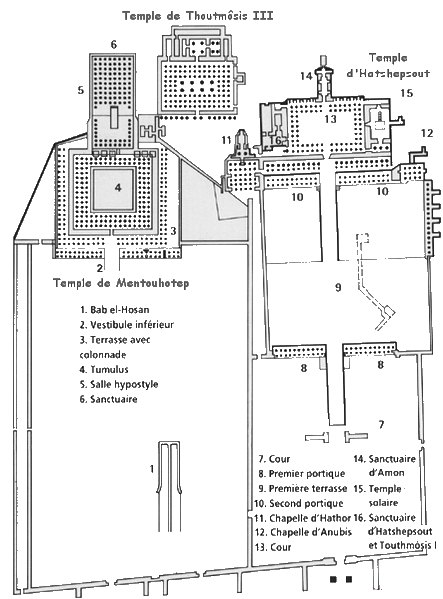
Mentuhotep II, the Eleventh Dynasty king who reunited Egypt at the beginning of the Middle Kingdom, built a very unusual funerary complex. His mortuary temple was built on several levels in the great bay at Deir el-Bahri. It was approached by a 16-metre-wide (150-ft) causeway leading from a valley temple which no longer exists.
The mortuary temple itself consists of a forecourt, enclosed by walls on three sides, and a terrace on which stands a large square structure that may represent the primeval mound that arose from the waters of chaos. As the temple faces east, the structure is likely to be connected with the sun cult of Rê and the resurrection of the king.
From the eastern part of the forecourt, an opening called the Bab el-Hosan ('Gate of the Horseman') leads to an underground passage and an unfinished tomb or cenotaph containing a seated statue of the king. On the western side, tamarisk and sycamore trees were planted beside the ramp leading up to the terrace. At the back of the forecourt and terrace are colonnades decorated in relief with boat processions, hunts, and scenes showing the king's military achievements.
Statues of the Twelfth Dynasty king Senusret III were found here too.
The inner part of the temple was actually cut into the cliff and consists of a peristyle court, a hypostyle hall and an underground passage leading into the tomb itself. The cult of the dead king centred on the small shrine cut into the rear of the Hypostyle Hall.
The mastaba-like structure on the terrace is surrounded by a pillared ambulatory along the west wall, where the statue shrines and tombs of several royal wives and daughters were found. These royal princesses were the priestesses of Hathor, one of the main ancient Egyptian funerary deities. Although little remained of the king's own burial, six sarcophagi were retrieved from the tombs of the royal ladies. Each was formed of six slabs, held together at the corners by metal braces and carved in sunken relief. The sarcophagus of Queen Kawit, now in the Cairo Museum, is particularly fine.
The burial shaft and subsequent tunnel descend for 150 meters and end in a burial chamber 45 meters below the court. The chamber held a shrine, which once held the wooden coffin of Nebhepetre Mentuhotep. A great tree-lined court was reached by means of the processional causeway, leading up from the valley temple. Beneath the court, a deep shaft was cut which led to unfinished rooms believed to have been intended originally as the king’s tomb. A wrapped image of the pharaoh was discovered in this area by Howard Carter. The temple complex also held six mortuary chapels and shaft tombs built for the pharaoh's wives and daughters.

Mortuary temple of Hatshepsut


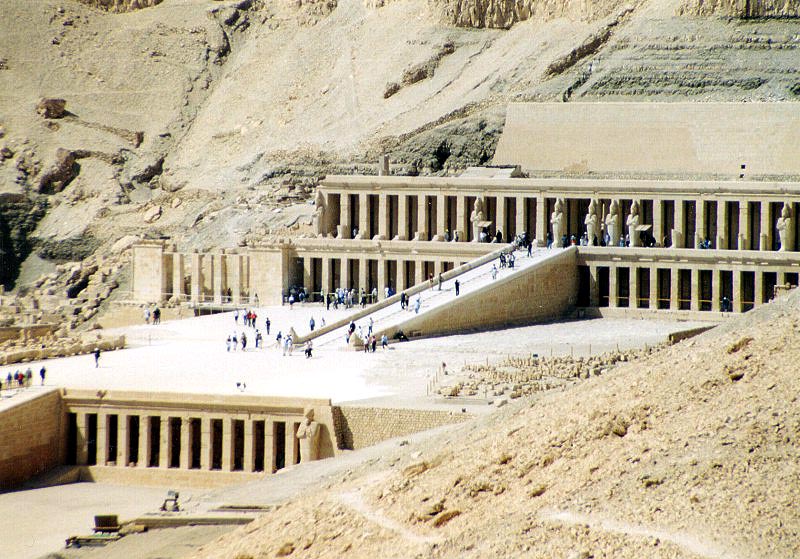
The focal point of the Deir el-Bahri complex is the Djeser-Djeseru meaning "the Holy of Holies", the Mortuary Temple of Hatshepsut. It is a colonnaded structure, which was designed and implemented by Senemut, royal steward and architect of Hatshepsut (and believed by some to be her lover), to serve for her posthumous worship and to honor the glory of Amun.
Djeser-Djeseru sits atop a series of colonnaded terraces, reached by long ramps that once were graced with gardens. It is built into a cliff face that rises sharply above it, and is largely considered to be one of the "incomparable monuments of ancient Egypt". It is 97 feet (30 m) tall

The unusual form of Hatshepsut's temple is explained by the choice of location, in the valley basin of Deir el-Bahri, surrounded by steep cliffs. It was here, in about 2050 BC, that Mentuhotep II, the founder of the Middle Kingdom, laid out his sloping, terrace-shaped mortuary temple. The pillared galleries at either side of the central ramp of the Djeser Djeseru correspond to the pillar positions on two successive levels of the Temple of Mentuhotep.
Today the terraces of Deir el-Bahri only convey a faint impression of the original intentions of Senenmut. Most of the statue ornaments are missing - the statues of Osiris in front of the pillars of the upper colonnade, the sphinx avenues in front of the court, and the standing, sitting, and kneeling figures of Hatshepsut; these were destroyed in a posthumous condemnation of this pharaoh. The architecture of the temple has been considerably altered as a result of misguided reconstruction in the early twentieth century A.D.


Architecture

While Hatshepsut used Menuhotep’s temple as a model, the two structures are significantly different. Hatshepsut employed a lengthy colonnaded terrace that deviated from the centralized massing of Menuhotep’s model – an anomaly that may be caused by the decentralized location of her burial chamber.


There are three layered terraces reaching 97 feet (30 m) in height. Each ‘story’ is articulated by a double colonnade of square piers, with the exception of the northwest corner of the central terrace, which employs Proto-Doric columns to house the chapel.
These terraces are connected by long ramps which were once surrounded by gardens. The layering of Hatshepsut’s temple corresponds with the classical Theban form, employing pylon, courts, hypostyle hall, sun court, chapel, and sanctuary.

The relief sculpture within Hatshepsut’s temple recites the tale of the divine birth of the pharaoh. The text and pictorial cycle also tell of an expedition to the Land of Punt, an exotic country on the Red Sea coast.


On either side of the entrance to the sanctuary (shown above) are painted pillars with images of Hathor as the capitals. Just under the roof is an image of Wadjet, displayed as a bilateral solar symbol, flanked by two other long serpents.
The temple includes an image, shown to the right, of Hatshepsut depicted as male pharaoh giving offerings to Horus, and to their left, an animal skin wound around a tall staff that is a symbol of the god Osiris.

While the statues and ornamentation have since been stolen or destroyed, the temple once was home to two statues of Osiris, a long avenue lined by sphinxes, as well as many sculptures of pharaoh Hatshepsut in different attitudes – standing, sitting, or kneeling.

Historical Influence

Hatshepsut’s temple is considered the closest Egyptians came to the Classical Architecture. It marks a turning point in the architecture of Ancient Egypt, which forsook the megalithic geometry of the Old Kingdom for a temple which allowed for active worship, requiring the presence of participants to create its majesty. The linear axiality of Hatshepsut’s temple is mirrored in the later New Kingdom temples.


Mortuary Temple of Thutmose III

Thutmose III built a temple complex here, dedicated to Amun. Discovered in 1961, it is believed to have been used during the Beautiful festival of the valley. Not much is known about the complex, as it was abandoned after sustaining severe damage during a landslide in the latter twentieth Dynasty. After that time it was used a source of building materials and in Christian times became the site of a Coptic cemetery.


Royal and non-royal tombs

An Eleventh dynasty shaft tomb located at the southern end of the complex contained a cache of forty royal mummies, moved there from the Valley of the Kings. The bodies had been placed there by Twenty-first Dynasty priests, most likely to prevent further desecration and looting.

In the cache were found the mummies of Ahmose I, along with the Eighteenth and Nineteenth dynasty leaders Amenhotep I, Thutmose I, Thutmose II, Thutmose III, Ramesses I, Seti I, Ramesses II, and Ramesses IX. In a separate room were found Twenty-first dynasty High Priests and pharaohs Pinedjem I, Pinedjem II, and Siamun. Later on, a cache of 153 reburied mummies of the priests themselves also were found in a tomb at the site.

Private tombs dating from the Middle Kingdom through the Ptolemaic period may be found here. There are two most notable private tombs at Deir el-Bahri. The first is that of Meketre (TT280), which contains many painted wooden funerary models from the Middle Kingdom and the first recorded human-headed canopic jar.
The second, the 'secret' tomb of Senenmut—the architect and steward who oversaw the construction of the temple for Hatshepsut—was begun in the complex also. Senenmut's tomb was vandalized in antiquity, but some of the relief artwork still is intact. It was meant to be a very large tomb and its corridors are over one hundred yards long, however, it was never finished and Senenmut was not interred there. He has another tomb, not far from Deir el-Bahri, where his body may have been placed, but it, too, was vandalized and robbed.

Valley of the Nobles in Luxor , Egypt

The Valley of The Nobles is located on the west bank of Luxor, in an area called Sheik Abd El-Korna. The site has rock cut tombs of Nobles, and high officials of ancient Egypt, who once served the Pharaohs during the time of the New Kingdom. (1500 - 500 BC)

Among the most important tombs in this cemetery is the tomb numbered 55, which belonged to Ra-Mose. He was the mayor of Thebes, and during the end of the reign of Amenhotep III (Amenophis III) and his son Akhenaton, the vizier.
Unfortunately this tomb is unfinished because Ra-Mose moved, with Akhenaton, to the new capital Akht-Aton (modern day Tell El-Amarna), therefore the decoration work stopped, and the tomb was left unfinished, except for the scenes which already had been completed. Because of this, we can appreciate the high techniques that Egyptian art had during that period
This tomb consists of a square rock-cut court, with a central doorway, opening into a broad columned hall with columns in the papyrus bud form. The inner hall is undecorated! On the left of the broad hall, and under the inner hall, were shafts’ leading below to two burial chambers, but the mummy of Ra-Mose was not found. The relief carving in this chapel is very fine and only some parts were painted
The tomb numbered 100 is another one of the important tombs in this cemetery; it belonged to Re-khme–e, who was vizier of Tuthmosis III and Amenhotep II.

It is another rock cut tomb and its walls are decorated with many painted scenes of the various aspects of life in Ancient Egypt. One of the most beautiful scenes is the one that represents the arrival of the foreign delegations to the court of the Vizier Re-khme-Re, carrying presents and tributes to the King of Egypt and his men. These presents and tributes included items such as, utensils, agricultural products and various animals. One of the most important text engraves in the this tomb is the one which mentions the duties and responsibilities assumed by the vizier in order to let the justice prevail on Earth.

When you visit the tombs, it is very important to know the number of the tomb you want to visit. This way you can visit exactly what you want to see; otherwise you will be lost, as many of the names of the Nobles are similar.

Here I have selected for you, some of the tombs that I recommend for you to visit.


The Tombs Chapel of Nakht, Number 52:

The owner of this tomb was one of the Nobles who had the title of the great scribe! He was also an astronomer in the Temple of Amon during the time of the reign of King Tuthmosis IV; his wife was also involved in the activities carried on in the Temple, as she worked as a chanter.


The tomb is fairly small but has one the most brilliant colourful scenes; these scenes are well preserved and have great beauty.


The tomb is decorated with scenes of agriculture, and a marvellous scene of Nakht in hunting action, together with his wife standing on a boatharpooning fish. Near to this scene, there is another one of him fowling in the marshes of the Delta, where he is catching birds using a boomerang.


Next, there is a wonderful scene where you can see some female musicians playing their instruments, while a blind singer sings for the crowds. You can also see crowds of people, who were invited to this party, watching the show, talking amongst each other and eating from a fruit laden table.


The Tomb of Menna N 69:


It is considered amongst the most famous tombs in the Valley of the Nobles, and one of the most beautiful, as it has many magnificent scenes and still remains in good condition


The tomb belonged to a Noble, who had the title of being the land surveyor during the time of King Tuthmosis IV. His job was important, as he was the one responsible for estimating how much in taxes should be levied, for the King, from the local farmers.

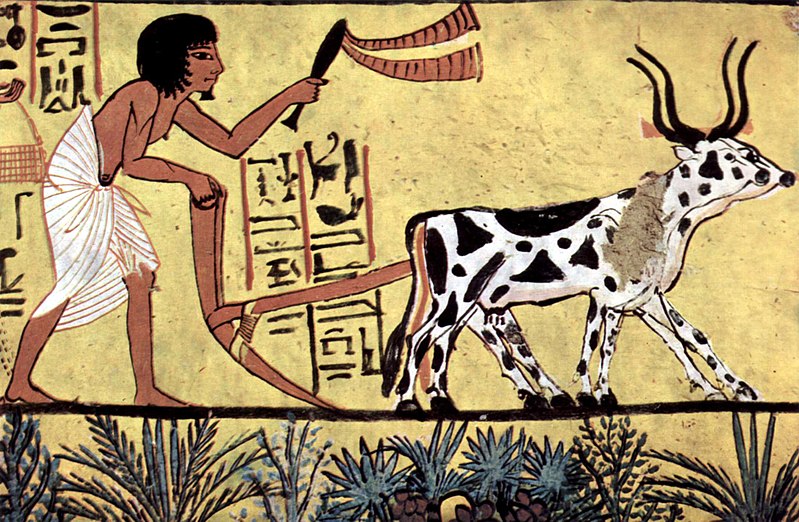
The tomb is full of scenes of daily life. There are scenes of cultivation, including harvesting, threshing, ploughing the fields and winnowing the seeds (separating the chaff from the seeds).


In the middle of the left wall, in the second register of the agriculture scenes, there is a very cute scene that depicts two girls fighting over falling seeds that passing farmers are dropping, while transporting them to the threshing ground.


This tomb also includes some offering scenes, here Menna and his wife are offering to the God Osiris.

There are also scenes of fishing and fowling in the marshes of the Nile. As well as all of the relief’s, there is also a destroyed statue of Menna and his wife, of which nothing remains but the feet!

When looking at the depictions of Menna on the walls, you will notice that his eyes have been destroyed! It seems that he had an enemy, who entered his tomb after the burial and destroyed the eyes in the paintings, meaning that Menna will never be able to see again in the after life.


The Tomb Chapel of Ra Mose


This is my passion and the best tomb so far. This marvelous tomb belongs to the vizier and counselor of the city of Thebes, who lived during the reigns of King Amonhotep III and Akhenaton (or Amenhotep IV) in the 18th Dynasty. In this tomb, there is a complete record of the new cult that Akhenaton, who was regarded as the heretic King, introduced and called Atonism.
Ra-mose lived until the 5th year of the reign of King Akhenaton. Evidence was found that proved that this tomb was opened and re-used by many other Noblemen in a later period; most probably they were the ones who erased the names of King Akhenaton of the walls of the tomb!

The high Priest Ra-mose of Amon Ra had great power! It is clear from the style of decoration inside this tomb, that he enjoyed a very unique position.


The most interesting part of the tomb was for the worshippers of the sun disk, the God Aton, which illuminates the name and figures of the wives and children of Akhenaton. Next to him, in this scene, there is another one of the high Priests with a long mantle and clean-shaven head.
On the interiors wall to the south, is the fine colour scene showing the funeral ceremony and female mourners. There you will see a group of servants carrying offerings to the deceased. On the eastern wall there is a fine specimen of relief sculpture made by the finest artists of the 18th Dynasty; here the scene shows Ra-mose’s wife, father, uncles and sisters.

There is also a large scene that shows Ra-mose sitting on a stool with his wife, and their pet goose sitting underneath.

On the southern wall of the tomb, there is a fresco that shows the funeral of Ra-mose, his possessions, and the offerings being made for him. In another scene you can see groups of mourners weeping and wailing. In front of them there is a Priest, standing at the entrance of the tomb.


Tomb #56 Userhet


Lonely Planet points out that the tombs of the Nobles, situated as they are among buildings of rather poor neighborhood in the village of Qurna, are some of the least visited tombs in the West Bank. Walking through town, we were surrounded by charming children whose limited English vocabulary was surprisingly well pronounced. The children begged us to buy these pitiful little charm dolls. I recall one girl about age 10, whose portrait I regrettfully failed to take, with dark brown skin and blond hair. I believe that she probably typifies the appearance of an ancient Egyptian child. At the tomb of Userhet, the thob wearing guard offered to reflect light into the tomb with a shiny piece of copper. So these photos of winemaking, daily life, and Userhet hunting gazelles from a chariot are partly a reflection of the guards efforts. Userhet was a royal scribe to Amenophis II.


Khaemhet's Tomb #57


Like Tombs of the Artisan's the Nobles tombs provide more of a view of real life in Egyptian times. This was the life of a poor agricultural worker, but rather of the work and family of a wealthy bureacrat. Khaemhet's tomb is marked as tomb #57 and is locked at night. The tomb has some wonderful reliefs, but the tomb was heavily damaged, perhaps by someone who lived there, because much of the art is heavily restored. Khaemhet was a court scribe and the walls of his tomb are richly decorated in heiroglyphics. He was also an inspector of granaries, under Amenophis III, and so the walls also depict in places agricultural life. At the far end of the tomb is a statue to two seated figures. The left one is greatly defaced, and is either Khaemhet's wife or the god of darkness. Khaemhet himself receives even at the corner some light shining on his face.


Tomb #96 Sennofer
 
Lonely Planet writes that Prince Sennofer of Thebes, supervisor of the gardens at the Temple of Amun in Karnak under Amenophis II, is frequently depicted with his sister. Interestingly though, the relationship appears more romantic, and since Sennofer is clearly a black Nubian and the woman, whether his sister or wife, is a white Egyptian. In any case, the paintings of grapes and vines on the ceiling.


Deir el-Medina in Luxor , Egypt

Deir el-Medina (Arabic: دير المدينة‎) is an ancient Egyptian village which was home to the artisans who worked on the tombs in the Valley of the Kings during the 18th to 20th dynasties of the New Kingdom period (ca. 1550-1080 BCE) The settlement's ancient name was "Set Maat" (translated as "The Place of Truth"), and the workmen who lived there were called “Servants in the Place of Truth”. During the Christian era the temple of Hathor was converted into a Church from which the Arabic name Deir el-Medina ( "the monastery of the town") is derived.
At the time when the world's press was concentrating on Howard Carter's discovery of the Tomb of Tutankhamun in 1922 a team led by Bernard Bruyère began to excavate the site. This work has resulted in one of the most thoroughly documented accounts of community life in the ancient world that spans almost four hundred years. There is no comparable site in which the organisation, social interactions, working and living conditions of a community can be studied in such detail.


The site is located on the west bank of the Nile, across the river from modern-day Luxor. The village is laid out in a small natural amphitheatre, within easy walking distance of the Valley of the Kings to the north, funerary temples to the east and south-east, with the Valley of the Queens to the west. The village may have been built apart from the wider population in order to preserve secrecy in view of sensitive nature of the work carried out in the tombs.


Excavation history

 
A significant find of papyri was made in the 1840s in the vicinity of the village and many objects were also found during the course of the 19th century. The archaeological site was first seriously excavated by Ernesto Schiaparelli between 1905-1909 which uncovered large amounts of ostraca . A French team directed by Bernard Bruyère excavated the entire site, including village, dump and cemetery, between 1922-1951. Unfortunately through lack of control it is now thought that about half of the papyri recovered was removed without the knowledge or authorisation of the team director Around five thousand ostrica of assorted works of commerce and literature were found in a well close to the village. Jaroslav Černý, who was part of Bruyère's team, went on to study the village for almost fifty years until his death in 1970 and was able to name and describe the lives of many of the inhabitants. The peak overlooking the village was renamed "Mont Cernabru" in recognition of Černý and Bruyère's work on the village.


The Village

 
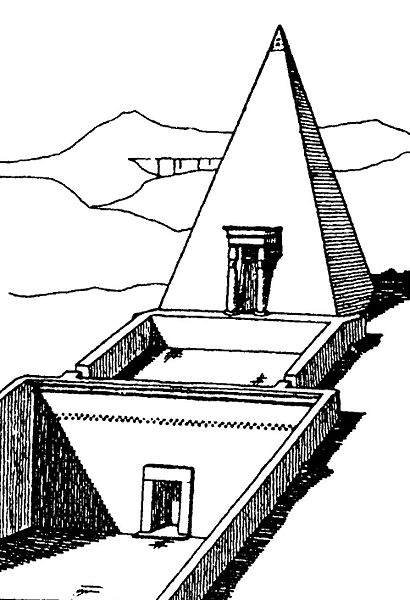
The first datable remains of the village belong to the reign of Thutmosis I (c. 1506-1493 BCE) with its final shape being formed during the Ramesside Period At its peak the community contained around sixty-eight houses spread over at total area of 5,600 sq. m. with a narrow road running the length of the village. The main road through the village may have been covered to shelter the villagers from the intense glare and heat of the sun. The size of the habitations varied, with an average floor space of 70 sq. m., but the same construction methods were used throughout the village. Walls were made of mudbrick, built on top of stone foundations. Mud was applied to the walls which were then painted white on the external surfaces with some of the inner surfaces whitewashed up to a height of around one metre. A wooden front door might have carried the occupants name. Houses consisted of four to five rooms comprising an entrance, main room, two smaller rooms, kitchen with cellar and staircase leading to the roof. The full glare of the sun was avoided by situating the windows high up on the walls. The main room contained a mudbrick platform with steps which may have been used as a shrine or a birthing bed. Nearly all houses contained niches for statues and small altars. The tombs built by the community for their own use include small rock-cut chapels and substructures adorned with small pyramids.

 
Due to its location, the village is not thought to have provided a pleasant environment: the walled village takes up the shape of the narrow valley in which its situated, with the barren surrounding hillsides reflecting the desert sun and the hill of Gurnet Murai cutting of the north breeze as well as the view of the verdant river valley. The village was abandoned c. 1110-1080 BCE during the reign of Ramesses XI (whose tomb was the last of the royal tombs built in the The Valley of the Kings) due to increasing threats of Libyan raids and the instability of civil war. The Ptolemies later built a temple to Hathor on the site of an ancient shrine dedicated to her.


Historical texts of Deir el-Medina

 
The surviving texts record the events of daily life rather than major historical incidents. Personal letters reveal much about the social relations and family life of the villagers. The ancient economy is documented by records of sales transactions that yield information on prices and exchange. Records of prayers and charms illustrate ordinary popular conceptions of the divine, whilst researchers into ancient law and practice find a rich source of information recorded in the texts from the village. Many examples of the most famous works of Ancient Egyptian literature have also been found. Thousands of papyri and ostraca still await publication.


Village life

 
The settlement was home to a mixed population of Egyptians, Nubians and Asiatics who were employed as labourers, ( stone-cutters, plasterers, water-carriers), as well as those involved in the administration and decoration of the royal tombs and temples. The artisans and the village were organised into two groups, left and right gangs who worked on opposite sides of the tomb walls similar to a ship's crew, with a foreman for each who supervised the village and its work.
As the main well was thirty minutes walk from the village carriers worked to keep the village regularly supplied with water. When working on the tombs the artisans stayed overnight in a camp overlooking the mortuary temple of Queen Hatshepsut (c. 1479–1458 BCE) that is still visible today. Surviving records indicate that the workers had cooked meals delivered to them from the village.
Based on analysis of income and prices, the workmen of the village would, in modern terms, be considered middle class. As salaried state employees they were paid in rations at up to three times the rate of a fieldhand, but unofficial second jobs were also widely practiced. At great festivals such as the heb sed the workmen were issued with extra supplies of food and drink to allow a stylish celebration.

 
The working week was eight days followed by two days holiday, though the six days off a month could be supplemented frequently due to illness, family reasons and, as recorded by the scribe of the tomb, rowing with wife or having a hangover. Including the days given over to festivals, over one-third of the year was time-off for the villagers during the reign of Merneptah (c. 1213-1203 BCE).
During their days off the workmen could work on their own tombs, and since they were amongst the best craftsmen in Ancient Egypt who excavated and decorated royal tombs, their own tombs are considered to be some of the most beautiful on the west bank.


A large proportion of the community, including women, could at least read and possibly write.
The jobs of the workers would have been considered desirable and prized positions with the posts being inheritable.

 
The examples of love songs recovered show how friendship between the sexes was practised, as was social drinking by both men and women. Egyptian marriages amongst commoners were monogamous but little is known about the marriage or wedding arrangements from surviving records. It was not unusual for couples to have six or seven children with some recorded as having ten.
Separation, divorce and remarriage occurred. Merymaat is recorded as wanting a divorce on account of his mother in-law's behaviour. Girl slaves could become surrogate mothers in cases were the wife was infertile and in doing so raise their status and procure their freedom
The community could move freely in and out of the walled village but for security reasons only outsiders who had good work related reasons could enter the site.


Women and village life

 
The records from this village provide most of the information we know about how women lived in the New Kingdom era. Women were supplied with servants by the government to assist with the grinding of the grain and laundry tasks. The wives of the workers cared for the children and baked the bread, a prime food source in these kind of societies. The vast majority of women who had a particular religious status embedded in their names were married to foremen or scribes and could hold the titles of chantress or singer with official positions within local shrines or temples, perhaps even within the major temples of Thebes. Under Egyptian law they had property rights more advanced than some of the British and American wives studying them. They had title to their own wealth and a third of all marital goods. This would belong solely to the wife in case of divorce or death of the husband. If she died first it would go to her heirs, not to her spouse. Brewing of beer was normally supervised by the Mistress of the House, though the workmen considered the monitoring of the activity as a legitimate excuse for taking time off work.


Law and order

 
The workers and their families were not slaves but free citizens with recourse to the justice system as required. In principle any Egyptian could petition the vizier and could demand a trial by his peers. The community had its own court of law made up of a foreman, deputies, craftsmen and a court scribe, and were authorised to deal with all civil and some criminal cases, typically relating to the non-payment of goods or services. The villagers represented themselves and cases could go on for several years, with one dispute involving the chief of police lasting eleven years. The local police, Medjay, were responsible for preserving law and order as well as controlling access to the tombs in the Valley of the Kings. One of the most famous cases recorded relates to Paneb the son of an overseer who was accused of looting royal tombs, adultery and causing unrest in the community. The outcome is not known but surviving records indicate the execution of a head of workmen at this time.
The people of Deir el-Medina often consulted with oracles about many aspects of their lives including justice. Questions could be put in writing or orally before the image of the god when carried by priests upon a litter. A positive response could have been made by a downward dip and a negative by a withdrawal of the litter. When a matter of justice came up and it wasn't resolved by a tribunal they would carry the statue to the accused and ask "Is it he who stole my goods" and if the statue nodded the accused would be considered guilty however at times the accused would deny guilt and demand to see another oracle or, in at least one case when that failed, he asked to see a third. When the third also nodded indicating guilt a judgement would be passed and he would have to make reparations and receive punishment. They also believed the oracle could punish or reward by bringing disease or blindness to people as punishment or miracle cures as rewards.


Popular piety

 
The excavations of the royal artisans community at Deir el-Medina have revealed much evidence of personal religious practice and cults. State gods were worshipped freely alongside personal gods without any conflict between national and local modes of religious expression.

The community had between sixteen-eighteen chapels, with the larger ones dedicated to Hathor , Ptah and Ramesses II. The workmen seem to have honoured Ptah and Reshep, the scribes Thoth and Seshat, as patron deities of their particular activity. Women had particular devotion towards Hathor, Taweret, and Bes in pregnancy, turning to Renenutet and Meretseger for food and safety. Meretseger, "Lady of the Western Mountain", was perhaps, at a local level, at least as important as Osiris, the great god of the dead.
The villagers held Amenhotep I (c. 1526-1506 BCE) and his mother Queen Ahmose Nefertari in high regard over many generations, possibly as divinized patrons of the community. When Amenhotep died he became the centre of a village funerary cult, worshipped as "Amenhotep of the Town". When the Queen died she also was deified and became "Mistress of the Sky" and "Lady of the West". Every year the villagers celebrated the Festival of Amenhotep I when the elders acted as priests in the ceremonies that paid honour to their own local gods who were not worshipped anywhere else in Egypt.
Prayers were made and dedicated to a particular deity as votive offerings, similar in style to the penitential psalms in the Hebrew scriptures that express remorse and thanksgiving for mercy. Stelae record sorrow for human error and humbly invoke a god for forgiveness and mercy. In one instance Meretseger is petitioned to bring relief to one in pain. She answer the prayer by bringing "sweet breezes". On another stela a workman writes: "I was a man who swore falsely by Ptah, Lord of Truth, and he caused me to see darkness by day. Now I will declaim his might to both the ignorant and the knowledgeable.” Amun was considered a special patron of the poor and one who was merciful to the penitent. A stelae records:


[Amun] who comes at the voice of the poor in distress, who gives breath to him who is wretched..You are Amun, the Lord of the silent, who comes at the voice of the poor, when I call to you in my distress You come and rescue me...Though the servant was disposed to do evil, the Lord is disposed to forgive. The Lord of Thebes spends not a whole day in anger, His wrath passes in a moment, none remains. His breath comes back to us in mercy..May your ka be kind, may you forgive, It shall not happen again.

 
Scene from the Tomb of Sennedjem Dream interpretation, a gift which Hebrew scriptures also attribute to Joseph, was very common. A book of dreams was found in Scribe Kenhirkhopeshef's library which was old even in his time. This book was used to interpret various types of dreams. These interpretations lacked precision and similar dreams often had different meanings. In many cases the interpretation was the opposite of what the dream depicted, for example a happy dream often signified sadness, a dream of plenty often signified scarceness etc.


Examples of how the dreams are interpreted include the following:


  • If a man sees himself dead this is good; it means a long life in front of him.
  • If a man sees himself eating crocodile flesh this is good; it means acting as an official amongst his people. (i.e. becoming a tax collector)
  • If a man sees himself with his face in a mirror this is bad; it means a new life.
  • If a man sees himself uncovering his own backside this is bad it means he will be an orphan later.


Strike


The royal building service was usually well run in view of the importance of the work it carried out. Paying proper wages was a religious duty that formed an intrinsic part of Maat. When this broke down it indicated problems in the wider state. The coming of the iron age and collapse of empire led to economic instability with inflation a notable feature. The high ideals expressed in the code of Maat became strained and this provided the background to workers unrest.


In about the 25th year the reign of Ramses III (c. 1170 BCE) the laborers were so exasperated by delays in supplies they threw down their tools and walked off the job in what may have been the first sit down strike in history. They wrote a letter to the Vizier complaining about lack of wheat rations. Village leaders attempted to reason with them but they refused to return to work until their grievances were addressed. They responded to the elders with "great oaths". "we are hungry", the crews claimed; "eighteen days have passed this month" and they still had not received their rations. They were forced to buy their own wheat. They told them to send to Pharaoh or vizier to address their concerns. After the authorities heard of their complaints they addressed them and they went back to work the next day. There were several strikes that followed after one of them when the strike leader asked the workers to follow him they told them they had enough and returned to work. This was not the last strike but they soon restored the regular wheat supplies and the strikes came to an end for the remaining years of Ramesses III. However since the chiefs supported the authorities the workers no longer trusted them and chose their own representatives.  Further complaints by the artisans are recorded forty and fifty years after the initial dispute, during the reigns of Ramesses IX and Ramesses X.

 
Tomb Robbing

 
After the reign of Ramses IV (c. 1155-1149 BCE) the conditions of the village became increasingly unsettled. At times there was no work for fear of the enemy. The grain supplies became less dependable and this was followed by more strikes. Gangs of tomb robbers increased often tunnelling in through the back so they wouldn't break the seal and be exposed. A tomb robbing culture developed that included fences and even some officials who accepted bribes. When the Vizier checked the tombs if the seals were undisturbed they wouldn't report it as being opened. When they finally did catch tomb robbers they used limb twisting tactics to interrogate the tomb robbers and obtain information about where the plunder was and who their accomplices were. On one occasion when some officials were looking for a scapegoat they obtained a confession from a repeat offender after torturing him. However the Vizier was suspicious at how easy he was produced and asked him to lead them to the tomb he robbed. He led them to an unfinished tomb that was never used and claimed it was the tomb of Isis.

The Ramesseum in Luxor , Egypt


The Ramesseum is the memorial temple (or mortuary temple) of Pharaoh Ramesses II("Ramesses the Great", also spelled "Ramses" and "Rameses"). It is located in the Theban necropolis in Upper Egypt, across the River Nile from the modern city of Luxor. The name – or at least its French form, Rhamesséion – was coined by Jean-François Champollion, who visited the ruins of the site in 1829 and first identified the hieroglyphsmaking up Ramesses's names and titles on the walls. It was originally called the House of millions of years of Usermaatra-setepenra that unites with Thebes-the-city in the domain of Amon.

Most splendid of these, in accordance with New Kingdom Royal burial practices, would have been his memorial temple: a place of worship dedicated to pharaoh, god on earth, where his memory would have been kept alive after his passing from this world. Surviving records indicate that work on the project began shortly after the start of his reign and continued for 20 years.

The design of Ramesses's mortuary temple abides by the standard canons of New Kingdom temple architecture. Oriented northwest and southeast, the temple itself comprised two stone pylons(gateways, some 60 m wide), one after the other, each leading into a courtyard. Beyond the second courtyard, at the centre of the complex, was a covered 48-column hypostyle hall, surrounding the inner sanctuary.

An enormous pylon (gateways, some 60 m wide) stood before the first court, with the royal palace at the left and the gigantic statue of the king looming up at the back.

As is customary, the pylons and outer walls were decorated with scenes commemorating pharaoh's military victories and leaving due record of his dedication to, and kinship with, the gods. In Ramesses's case, much importance is placed on the Battle of Kadesh (ca. 1285 BC); more intriguingly, however, one block atop the first pylon records his pillaging, in the eighth year of his reign, a city called "Shalem", which may or may not have been Jerusalem.

The scenes of the great pharaoh and his army triumphing over the Hittite forces fleeing before Kadesh, represented in line with the canons of the "epic poem of Pentaur", can still be made out of the pylon.

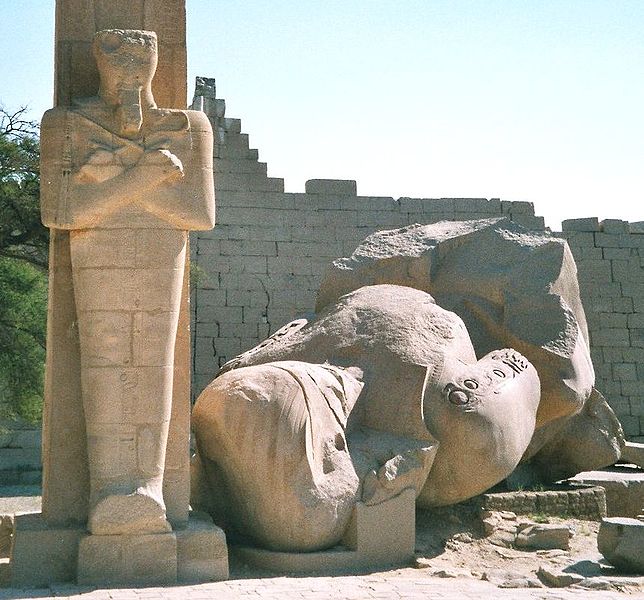
Only fragments of the base and torso remain of the syenite statue of the enthroned pharaoh, 62 feet (19 metres) high and weighing more than 1000 tons. This was alleged to have been transported 170 miles over land. This is the largest remaining colossal statue (except statues done in situ) in the world. However fragments of 4 granite Colossi of Ramses were found in Tanis (northern Egypt). Estimated height is 69 to 92 feet (21 to 28 meters). Like four of the six colossi of Amenhotep III (Colossi of Memnon) there are no longer complete remains so it is based partly on unconfirmed estimates.

Remains of the second court include part of the internal façade of the pylon and a portion of the Osiride portico on the right. Scenes of war and the rout the Hittites at Kadesh are repeated on the walls. In the upper registers, feast and honour of the phallic god Min, god of fertility.On the opposite side of the court the few Osiride pillars and columns still left can furnish an idea of the original grandeur. Scattered remains of the two statues of the seated king can also be seen, one in pink granite and the other in black granite, which once flanked the entrance to thetemple. Thirty-nine out of the forty-eight columns in the great hypostyle hall (m 41x 31) still stand in the central rows. They are decorated with the usual scenes of the king before various gods. Part of the ceiling decorated with gold stars on a blue ground has also been preserved. The sons and daughters of Ramesses appear in the procession on the few walls left. The sanctuary was composed of three consecutive rooms, with eight columns and the tetrastyle cell. Part of the first room, with the ceiling decorated with astral scenes, and few remains of the second room are all that is left.

Adjacent to the north of the hypostyle hall was a smaller temple; this was dedicated to Ramesses's mother, Tuya, and his beloved chief wife,Nefertari. To the south of the first courtyard stood the temple palace. The complex was surrounded by various storerooms, granaries, workshops, and other ancillary buildings, some built as late as Roman times.

A temple of Seti I, of which nothing is now left but the foundations, once stood to the right of the hypostyle hall. It consisted of a peristyle court with two chapel shrines. The entire complex was enclosed in mud brick walls which started at the gigantic southeast pylon.

A cache of papyri and ostraca dating back to the third intermediate period (11th to 8th centuries BC) indicates that the temple was also the site of an important scribal school.

The site was in use before Ramesses had the first stone put in place: beneath the hypostyle hall, modern archaeologists have found a shaft tomb from the Middle Kingdom, yielding a rich hoard of religious and funerary artifacts.


Remains

Unlike the massive stone temples that Ramesses ordered carved from the face of the Nubian mountains at Abu Simbel, the inexorable passage of three millennia was not kind to his "temple of a million years" at Thebes. This was mostly due to its location on the very edge of the Nilefloodplain, with the annual inundation gradually undermining the foundations of this temple, and its neighbours. Neglect and the arrival of new faiths also took their toll: for example, in the early years of the Common Era, the temple was put into service as a Christian church.

This is all standard fare for a temple of its kind built at the time it was. Leaving aside the escalation of scale – whereby each successive New Kingdom pharaoh strove to outdo his predecessors in volume and scope – the Ramesseum is largely cast in the same mould as Ramesses III'sMedinet Habu or the ruined temple of Amenhotep III that stood behind the "Colossi of Memnon" a kilometre or so away. Instead, the significance that the Ramesseum enjoys today owes more to the time and manner of its rediscovery by Europeans.

Excavation and Studies

The origins of modern Egyptology can be traced to the arrival in Egypt of Napoleon Bonaparte in the summer of 1798. While undeniably an invasion by an alien imperialist power, this was nonetheless an invasion of its times, informed by Enlightenment ideas: alongside Napoleon's troops went men of science, the same whose toil under the desert sun would later yield the seminal 23-volume Description de l'Égypte. Two French engineers, Jean-Baptiste Prosper Jollois and Édouard de Villiers du Terrage, were assigned to study the Ramesseum site, and it was with much fanfare that they identified it with the "Tomb of Ozymandias" or "Palace of Memnon" of which Diodorus of Sicily had written in the 1st century BC.

It was against the backdrop of intense excitement surrounding the statue's arrival, and having heard wondrous tales of other, less transportable treasures still in the desert, that the poet Percy Bysshe Shelleypenned his sonnet "Ozymandias". In particular, one massive fallen statue at the Ramesseum is now inextricably linked with Shelley, because of the cartouche on its shoulder bearing Ramesses's throne name, User-maat-re Setep-en-re, the first part of which Diodorus transliterated into Greek as "Ozymandias". While Shelley's "vast and trunkless legs of stone" owe more to poetic license than to archaeology, the "half sunk... shattered visage" lying on the sand is an accurate description of part of the wrecked statue. The hands, and the feet, lie nearby. Were it still standing, the Ozymandias colossus would tower 18 metres above the ground, rivalling the Colossi of Memnon and the statues of Ramesses carved into the mountain at Abu Simbel.The next visitor of note was Giovanni Belzoni, a showman and engineer of Italian origin and, latterly, an archaeologist and antiques dealer. Belzoni's travels took him in 1815 to Cairo, where he soldMehemet Ali a hydraulic engine of his own invention. There he met British Consul General Henry Salt, who hired his services to collect from the temple in Thebes the so-called 'Younger Memnon', one of two colossal granite heads depicting Ramesses II, and transport it to England. Thanks to Belzoni's hydraulics and his skill as an engineer (Napoleon's men had failed in the same endeavour a decade or so earlier), the 7-ton stone head arrived in London in 1818, where it was dubbed "The Younger Memnon" and, some years later, given pride of place in the British Museum.

Medinet Habu (temple) in Luxor , Egypt


Medinet Habu is the name commonly given to the Mortuary Temple of Ramesses III, an important New Kingdom period structure in the location of the same name on the West Bank of Luxor in Egypt. Aside from its intrinsic size and architectural and artistic importance, the temple is probably best known as the source of inscribed reliefs depicting the advent and defeat of the Sea Peoples during the reign of Ramesses III.

The temple, some 150 m long, is of orthodox design, and resembles closely the nearby mortuary templeof Ramesses II (the Ramesseum). The temple precinct measures approximately 700 ft (210 m). by 1,000 ft (300 m) and contains more than 75,350 sq ft (7,000 m2) of decorated wall reliefs.[1] Its walls are relatively well preserved and it is surrounded by a massive mudbrick enclosure, which may have been fortified. The original entrance is through a fortified gate-house, known as a migdol (a common architectural feature of Asiatic fortresses of the time).

Just inside the enclosure, to the south, are chapels of Amenirdis I, Shepenupet II and Nitiqret, all of whom had the title of Divine Adoratrice of Amun.

The first pylon leads into an open courtyard, lined with colossal statues of Ramesses III as Osiris on one side, and uncarved columns on the other. The second pylon leads into a peristyle hall, again featuring columns in the shape of Ramesses. This leads up a ramp that leads (through a columned portico) to the third pylon and then into the large hypostyle hall (which has lost its roof). Reliefs and actual heads of foreign captives were also found placed within the temple perhaps in an attempt to symbolise the king's control over Syria and Nubia.

In Coptic times, there was a church inside the temple structure, which has since been removed. Some of the carvings in the main wall of the temple have been altered by coptic carvings.

Initial excavation of the temple took place sporadically between 1859 and 1899, under the auspices of the Egyptian Antiquities Service. During these decades the main temple was cleared, a large number ofCoptic period buildings removed and the site made accessible to visitors.

The further excavation, recording and conservation of the temple has been facilitated in chief part by theArchitectural and Epigraphic Surveys of Chicago University's Oriental Institute, almost continuously since 1924.

Valley of the Queens in Luxor , Egypt


The Valley of the Queens, is a place in Egypt where wives of Pharaohs were buried in ancient times. In ancient times, it was known as Ta-Set-Neferu, meaning –‘the place of the Children of the Pharaoh’, because along with the Queens of the 18th, 19th and 20th dynasties (1550–1070 BCE) many princes and princesses were also buried with various members of the nobility. The tombs of these individuals were maintained by mortuary priests who performed daily rituals and provided offerings and prayers for the deceased nobility.

The valley is located near the better known Valley of the Kings, on the west bank of the Nileacross from Thebes (modern Luxor) . This barren area in the western hills was chosen due to its relative isolation and proximity to the capital. The kings of the 18th dynasty, instead of the traditional building of pyramids as burial chambers (perhaps because of their vulnerability totomb robbers), now chose to be buried in rock-cut tombs.

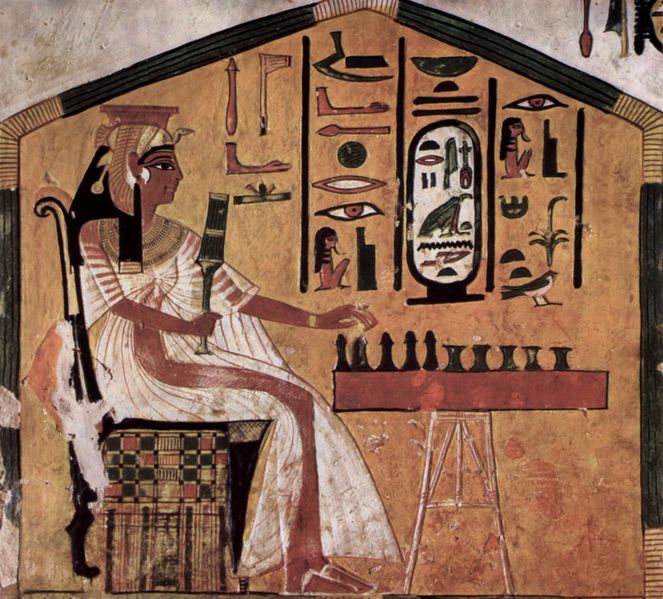
This necropolis is said to hold more than seventy tombs, many of which are stylish and lavishly decorated. An example of this is the resting place carved out of the rock for Queen Nefertari (1290–1224 BCE) of the 19th Dynasty. Thepolychrome reliefs in her tomb are still intact.


Principal burials