
Kom Ombo stands by the Nile just south of Gebel el-Silsila, between Aswan and Edfu, at the site of the ancient city of Per Sobek (the estate of Sobek). The Temple of Sobek and Horus the Elder is an unconventional temple in that it is dedicated to two triads of deities; Sobek, Hathor and their child Khonsu, and Horus the Elder (Heru-ur or Haroeris), Tasenetnofret ("the good sister") and their child Panebtawy (the Lord of the Two Lands). Sobek and Horus the Elder are the two primary gods, and so the temple was also known as "House of the Crocodile" (Sobek) and "Castle of the Falcon" (Horus).
Showing posts with label Aswan. Show all posts
Showing posts with label Aswan. Show all posts
Nubian settlement

The inhabitants of old Nubia formed riverine communities clustered in villages along the banks of the Nile. Prior to relocation, Nubia was located between Aswan in Egypt and 150 kilometers into Sudan. The Kenuz occupied the northern area, the Arabs resided in the middle, and the Nubians were located in the south of Egypt and the north of Sudan. About 50,000 Sudanese Nubians and 70,000 Egyptian Nubians were relocated. There were attempts in the relocation plans to maintain the location of the villages in relation to each other.

Kom Ombo in Aswan, Egypt

Abu Simbel near Aswan, Egypt
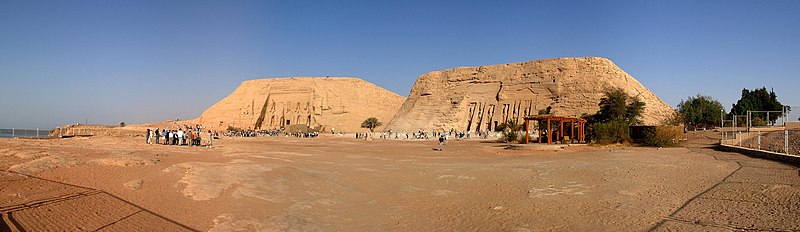
Temple of Kalabsha in Aswan , Egypt

The Temples of Philae on Agilika Island in Aswan , Egypt

In the 20th Century the island of Philae was flooded by the Low Dam. The High Dam waters of Lake Nasser completely submerged the island when it was be completed.
The temples on the island were therefor completely dismanteled and moved about 550 Meters north of Philae, between the years 1972 - 1980 AD to the island of Agilika on Lake Nasser.
Today it is still commonly said that the various monuments are on Philae Island, even though they really are on Agilika Island.
Tradition said that it was from Philae (Pilak in Egyptian) that Isis watched over the tomb of Osiris on the neighboring island of Biga. The Temple Of Isis and Horus The Child dominated the group of monuments erected between the 26th Dynasty and the Roman Period.
St. Simeon Monastery (Monastery of Anba Hatre) in Aswan, Egypt

General View of the Monastery of St. Simeon
 Those on a fairly standard tour of Egypt that includes the Aswan area will most likely visit St. Simeon (Deir Anba Sim'an), the monastery otherwise known as Anba Hatre. It is very likely that this will also include their one substantial camel ride (about 15 minutes), which is how these ruins, located some one thousand two hundred meters from the west bank oppose the southern tip of the island of Elephantine, are usually accessed. The monastery was given the name St. Simeon by archaeologists and travelers, but earlier Arabic and Coptic sources called it Anba Hatre (Hidra, Hadri, Hadra),
Aga Khan Mausoleum in Aswan , Egypt
It is often said that the River Nile manifests its beauty at its best at Aswan, Egypt's most southern city, where white-sailed feluccas glide across the clear, blue water.

The residents of Aswan are friendly and less likely to hassle you than other cities in Egypt that attract large numbers of visitors. And large numbers there are. The warm, year-round climate and the tropical vegetation give the town a distinctly African feel. The next stop is Sudan. Of all the things to see in this delightful place, the most pleasant thing of all is just to walk and to take in the atmosphere.
Tombs of Mekhu and Sabni in Aswan , Egypt
 Monument Number : 25 and 26
Period : Old kingdom
Founder : Sabni
Construction date : Century 23 (0) BC
State : Preserved
Address: At Qubbet el-Hawa, Aswan
Mekhu and Sabni were father and son , both were governors of Upper Egypt during the reign of Pepi II of the 6th Dynasty . The reliefs on the walls of the tombs tell the story of the killing of Mekhu while he was on an expedition in Nubia and the efforts of his son , Sabni , to bring the body of his father back as well as his ceremonial burial . Sabni informed King Pepi II of the event and the king sent his personal embalmers to mummify the deceased governor . The tombs follow the Old Kingdom's style , with small obelisks and offering table at the entrance doorway . The Offering table of Mekhu still stands there .
The tomb of Mekhu , to the left side , has 18 columns and a niche in the back wall . The decoration , in reliefs , show daily life scenes of the deceased .
Aswan Tombs of the Nobles , Egypt
The riverscape of Aswan is dominated by the sand-covered hills of the West Bank which is strewn with rock-cut tombs of high-status officials of the Old and Middle Kingdom. At the crest of the hill is the domed tomb of a Muslim prophet which gives the hill its local name, Qubbet el-Hawa or ‘Dome of the Winds’. 
The ticket office is to the northern end of the tomb area and a steep climb up several flights of stone steps leads to the upper level of the cemetery where there are around 6 or 7 tombs open to visitors. The guide will usually begin at the southern end of the upper level where the most interesting tombs can be seen. These ancient tombs are roughly cut from the natural rock, and though they are not as well preserved as some of those to be visited in the Luxor or Cairo areas they are well worth seeing. Tombs of this period are usually fairly inaccessible in most places south of Cairo and these show fine examples of hieroglyphic texts detailing the careers of their owners as well as scenes of daily life in the earlier periods. Many of the tombs are linked together as family members added their own chambers.
Tombs 25/26: Sabni and Mekhu
The owners of these tombs were father and son, both Overseers of Upper Egypt in Dynasty VI during the reign of Pepy II. Reliefs on the walls of Mekhu’s tomb record his murder while on an expedition in Nubia and the revenge taken by Sabni, his son. He seems to have been buried with much ceremony. The tombs were roughly constructed in Old Kingdom style, with small obelisks at the entrance doorway and an offering table of Mekhu still in situ.
Tomb 31: Sarenput II
The next major tomb in the sequence is that of Sarenput II, Overseer of the Priests of Khnum and Commander of the Garrison at Elephantine, dated to the reign of Dynasty XII king, Amenemhet II. This is one of the best preserved tombs at Aswan. It consists of a large chamber with six perfectly symmetrical undecorated pillars and a gallery flanked by six niches each once containing mummiform statues of the deceased prince. The four pillars of a second chamber were decorated with images of Sarenput. Beyond this, a chapel cut deep into the rock is plastered and painted in vivid colours and depicts his wife, a Priestess of Hathor and other family members. In the niche at the back of the chapel Sarenput is named as ‘Hereditary Lord’. This biographical text is very colourful with well-depicted hieroglyphs and shows the cartouche of ‘Nebkaure’ – Amenemhet II as well as an unusual glyph of an elephant. The style of painting and the hieroglyphs are distinctly similar to the Old Kingdom tombs, leading some Egyptologists to suggest that the same artists decorated them and that the length of the 1st Intermediate Period was therefore very short.
Tomb 31: Khunes
This is a Dynasty VI tomb, its owner Khunes was a Lector Priest and Chancellor. A side chamber to the left of the entrance was re-used as a Coptic cell and another chamber on an upper level was a serdab. The tomb contains scenes of the deceased and his family in daily life.
Tomb 31: Harkhuf
Harkhuf was an Overseer of Foreign Troops during the reigns of Pepy I, Merenre and Pepy II in Dynasty VI. This tomb is famous for Harkhuf’s biographical text and a copy of a letter from Pepy II requesting that Harkhuf should hurry to bring the young king a dancing pigmy from an expedition into Africa.
Tomb 35: Pepynakht (also called Heqa-ib)
The owner of this tomb was another Overseer of Foreign Troops during the reign of Pepy II of Dynasty VI. The tomb has a columned façade, biographical texts and good reliefs showing hunting and bull-fighting scenes. Heqa-ib was the deified official whose cult chapel stood on Elephantine Island.
Tomb 36: Sarenput I
The last major tomb on the upper level dates from Dynasty XII and the reign of Senwosret I. Sarenput I was a Governor of Elephantine and Overseer of the Priests of Satis. A columned court has scenes on the rear walls of the deceased hunting and fishing with his dogs and his sandal-bearer. In a hall with four columns there are scenes of daily life, a boating scene and a biographical text with finely painted hieroglyphs. A chamber at the rear of the tomb has a ‘false door’.

Note the causeways which run down the hillside from the different cemetery levels. These would have been the original ‘paths’ to the tombs and coffins and burial goods would have been dragged up these steep inclines from the river. At night the whole cemetery area is floodlit and can be seen from all over Aswan.
The tombs are mostly quite deep in the hillside and therefore very dark. Photography is not usually allowed.
Note the causeways which run down the hillside from the different cemetery levels. These would have been the original 'paths' to the tombs and coffins and burial goods would have been dragged up these steep inclines from the river. At night the whole cemetery area is floodlit and can be seen from all over Aswan.
The tombs are mostly quite deep in the hillside and therefore very dark. Flash photography is not usually allowed.
How to get there
To get to the Tombs of the Nobles, there is a ferry which leaves from the northern end of the Corniche. Alternatively you can hire a felucca which will wait and bring you back. You could also combine a visit to the tombs with a longer felucca trip.
Tombs 25/26: Sabni and Mekhu
The owners of these tombs were father and son, both Overseers of Upper Egypt in Dynasty VI during the reign of Pepy II. Reliefs on the walls of Mekhu’s tomb record his murder while on an expedition in Nubia and the revenge taken by Sabni, his son. He seems to have been buried with much ceremony. The tombs were roughly constructed in Old Kingdom style, with small obelisks at the entrance doorway and an offering table of Mekhu still in situ.
Tomb 31: Sarenput II
The next major tomb in the sequence is that of Sarenput II, Overseer of the Priests of Khnum and Commander of the Garrison at Elephantine, dated to the reign of Dynasty XII king, Amenemhet II. This is one of the best preserved tombs at Aswan. It consists of a large chamber with six perfectly symmetrical undecorated pillars and a gallery flanked by six niches each once containing mummiform statues of the deceased prince. The four pillars of a second chamber were decorated with images of Sarenput. Beyond this, a chapel cut deep into the rock is plastered and painted in vivid colours and depicts his wife, a Priestess of Hathor and other family members. In the niche at the back of the chapel Sarenput is named as ‘Hereditary Lord’. This biographical text is very colourful with well-depicted hieroglyphs and shows the cartouche of ‘Nebkaure’ – Amenemhet II as well as an unusual glyph of an elephant. The style of painting and the hieroglyphs are distinctly similar to the Old Kingdom tombs, leading some Egyptologists to suggest that the same artists decorated them and that the length of the 1st Intermediate Period was therefore very short.
Tomb 31: Khunes
This is a Dynasty VI tomb, its owner Khunes was a Lector Priest and Chancellor. A side chamber to the left of the entrance was re-used as a Coptic cell and another chamber on an upper level was a serdab. The tomb contains scenes of the deceased and his family in daily life.
Tomb 31: Harkhuf
Harkhuf was an Overseer of Foreign Troops during the reigns of Pepy I, Merenre and Pepy II in Dynasty VI. This tomb is famous for Harkhuf’s biographical text and a copy of a letter from Pepy II requesting that Harkhuf should hurry to bring the young king a dancing pigmy from an expedition into Africa.
Tomb 35: Pepynakht (also called Heqa-ib)
The owner of this tomb was another Overseer of Foreign Troops during the reign of Pepy II of Dynasty VI. The tomb has a columned façade, biographical texts and good reliefs showing hunting and bull-fighting scenes. Heqa-ib was the deified official whose cult chapel stood on Elephantine Island.
Tomb 36: Sarenput I
The last major tomb on the upper level dates from Dynasty XII and the reign of Senwosret I. Sarenput I was a Governor of Elephantine and Overseer of the Priests of Satis. A columned court has scenes on the rear walls of the deceased hunting and fishing with his dogs and his sandal-bearer. In a hall with four columns there are scenes of daily life, a boating scene and a biographical text with finely painted hieroglyphs. A chamber at the rear of the tomb has a ‘false door’.
The tombs are mostly quite deep in the hillside and therefore very dark. Photography is not usually allowed.
Note the causeways which run down the hillside from the different cemetery levels. These would have been the original 'paths' to the tombs and coffins and burial goods would have been dragged up these steep inclines from the river. At night the whole cemetery area is floodlit and can be seen from all over Aswan.
The tombs are mostly quite deep in the hillside and therefore very dark. Flash photography is not usually allowed.
How to get there
To get to the Tombs of the Nobles, there is a ferry which leaves from the northern end of the Corniche. Alternatively you can hire a felucca which will wait and bring you back. You could also combine a visit to the tombs with a longer felucca trip.
Sehel Island in Aswan , Egypt
 On the summit of the eastern hill stands the most well-known of the rock-inscriptions on Sehel Island, known as the ‘Famine Stela’. The inscription is bruised lightly onto a large granite boulder and tells a story set in Dynasty III during the reign of the Horus Netjerikhet, king Djoser. The dating however is artificial, the text was carved during the Ptolemaic Period, shown by the style of the vocabulary and grammar and by the deification of Djoser’s architect Imhotep. It is possible that the text was re-worded from an earlier document but whatever the source, this is the earliest known connection between the names of the Pharaoh Netjerikhet, owner of the Step Pyramid at Saqqara and the name of King Djoser, by which he is now best known. The stela depicts King Djoser offering to the deities Khnum-Re, Satis and Anukis of the cataract region. The vertical rows of text below refer to the catastrophic effects of seven years of famine and drought during the reign of Djoser and how in a dream the god Khnum appeared to the king and promised to end the hardship if his instructions on the building of a temple at Elephantine were followed. The temple was duly built and a decree issued that a tax of one tenth of all produce from harvest, hunting and fishing as well as a proportion of precious minerals and materials brought from Nubia, should be donated to the temple of Khnum. No other official or administrator would be allowed to tax the people in the area designated by the king. It has been suggested that the erection of this stela was another case of political propaganda by the local priests of Khnum, on finding that the nearby Temple of Isis at Philae was gaining power in the region and that Khnum’s hold over the area from Aswan north to Esna was diminishing. Surely a decree of such apparent antiquity and under the protection of Khnum himself could not be ignored.
Aswan Botanical Garden , Egypt

 Lord Horatio Kitchener
The island where the Aswan Botanical Gardens are located was originally used by the Nubians, however in 1899 it was given to the prominent British soldier Lord Horatio Kitchener after a successful military operation in Sudan. At the time, Kitchener was the commander of Egypt's army and was also assigned to the area to complete a mapping survey for the British government.
The survey also collected data on the topography of the region, as well as information on the local flora and fauna. The results of the survey were published in an eight volume series, with Kitchener's contribution in the first three tomes (Conder and Kitchener 1881-1885).
This survey has had a lasting effect on the Middle East and the data compiled is still used by archaeologists and geographers today.
Elephantine Island in Aswan , Egypt
 Elephantine (Arabic: جزيرة الفنتين) is an island in the River Nile, located just downstream of the First Cataract at the southern border of Ancient Egypt. This region is referred to as Upper Egypt because the land is higher than that near the Mediterranean coast. It may have received its name because it was a trading place for Ivory[citation needed]. Other theories claim that the island is named after its shape. It is easily verifiable that the island's shape is similar to that of an elephant's tusk. This is the meaning of the Greek word elephas (ελέφας). This hypothesis does not explain how the ancients knew the shape of the island.
Unfinished Obelisk in Aswan , Egypt
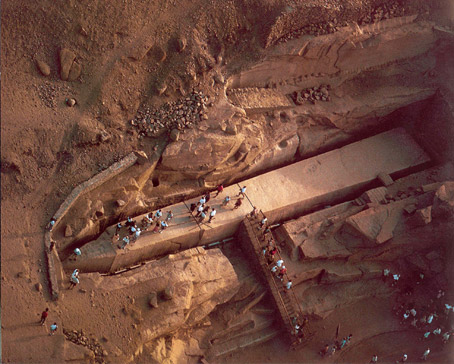 Much of the red granite used for ancient temples and colossi came from quarries in the Aswan area. Around these quarries are many inscriptions, many of which describe successful quarrying projects. The Unfinished Obelisk located in the Northern Quarry still lies where a crack was discovered as it was being hewn from the rock. Possibly intended as a companion to the Lateran Obelisk, originally at Karnak but now in Rome, it would have weighed over 2.3 million pounds and would have been the worlds largest piece of stone ever handled. However, a crack in the stone occurred, which caused it to be abandoned. Tools left by it's builders have given us much insight into how such work was performed.
 Given the primitive soft-metal tools of the ancient Egyptians, the obelisk in the Northern Quarry shows us an amazing feat of technology and archaeologists have learned much about the techniques of stone-cutting from examining this abandoned monument and from the tools which have been left behind. It would appear that the stone, which measures 42m in length and would have weighed around 1216 tonnes, developed a flaw during quarrying and was never completed, left to lie still attached to the rock for the next 3000 years. It has been a tourist attraction for almost as long.

The Northern Quarry is an fascinating place to visit for those interested in early technologies. It is famous for producing the granite used in the construction of the burial chamber of the Great Pyramid of Khufu as well as some of the casing stones in other pyramids. Every rock face shows the imprint of ancient stone workers with many cut-marks or artists sketches still to see. You can almost believe that the workmen have only just put down their tools and gone home for the night.
The area of the northern quarry has been recently excavated and renovated by the SCA, its mounds of rubble cleared to reveal many previously unknown granite objects, including fragments of columns and statues. Archaeologists have been able to get a clearer picture of how the stone was cut, carved and transported and have found several ancient tools and artists' sketches. To the south of the unfinished obelisk, excavators found a hieroglyphic inscription dated to year 25 of the reign of Tuthmose III, an instruction from the King for the quarrying of two large obelisks to be erected in Karnak Temple and dedicated to Amun-Re. They also uncovered, close to the unfinished obelisk, the depressions made from the hewing of seven large obelisks, possibly those in Karnak and Luxor temples. Another important discovery was a harbour from where the stone was shipped northwards along the Nile, its walls revealing decorative graffiti of the god Bes, ostriches and fish.
The site is now landscaped and re-opened and offers wide wooden walkways and steps between the many different levels of the quarry with a good viewing platform at either end of the unfinished obelisk. A visitors centre and open-air museum to display some of the artefacts, along with the inevitable tourist bazaar completes this unique experience.
Nubia Museum in Aswan, Egypt
In the early 1960's, when Egypt built the High Dam at Aswan, Egyptologists and archaeologists the world over heeded UNESCO's appeal to salvage the monuments of Egyptian Nubia before the rising waters of Lake Nasser submerged them forever. More than sixty expeditions ultimately joined the "Nubian Rescue Campaign", which resulted in the excavation and recording of hundreds of sites, the recovery of thousands of objects, and the salvage and translocation of a number of important temples to higher ground.
 Due to the quantities of material recovered from tombs, temples and settlements, UNESCO was encouraged in the 1980's to plan a new Nubian museum in Aswan where the objects could be stored and exhibited. It was universally felt at the time that they should be kept as close as possible to their principal places of origin.
 Nearly twelve years later, the Museum became a reality and opened its doors in November 1997. It was designed by the late Egyptian architect Mahmoud al-Hakim, and Mexican architect Pedro Vasquez Ramirez designed the museum's interior display. The Museum won the Agha-Khan Award of Architecture 2001.
The total area of the complex is 50,000 square meters: 7,000 allocated for the building, and 43,000 for the grounds. The architecture of the Museum and the enclosure walls are intended to evoke traditional Nubian village architecture, as it was along the Nubian Nile before the region was flooded by Lake Nasser.
The building is set within a landscape, on graded levels, that includes a sequence of waterfalls. When the waterway reaches the lower part of the garden, it divides into 2 branches to surround an open-air stage and amphitheater where already many local and foreign groups have performed. The remaining 43,000 sq. m. have been planted with palm trees, flowers, and climbing plants, spread over natural rocks. An outdoor exhibit is planned for the garden, but at the moment only a small section is ready. The project is a beautiful resolution of a long-awaited dream.
The collections of the Nubia museum are composed of artefacts found on sites now submerged, during the Unesco salvage campaign. They are also composed of collections from a variety of museums in Egypt, collected in Nubia during the first half of the twentieth century. It displays in its permanent exhibition about 1500 artefacts showing, in chronological order, the material culture of Nubia, from Prehistory to present times. Virtually all the objects on display were found in Egyptian Nubia with the exception of a few pieces that are included because they clearly relate to Nubia and help elucidate Nubian history and its environment.
Open air museum
The site surrounding the Museum has received considerable landscaping work which has been designed to enhance and fit in with the major existing topographical features. It has been planted with palm trees, flowers and climbing plants, through which a watercourse flows to the rear of the Museum, falling both across and down the site, over a series of weirs to accommodate the natural fall of the ground.
 The pathway around the site -along with other paved areas, sitting areas, etc. - is constructed from granite and sandstone paving and steps, and in addition to providing access around the site, also lead to the various artefacts composing the Museum's outdoor exhibition.
 Islamic religious buildings and antiquities occupy the Northern end of the site. To the South can be found an artificial cave containing prehistoric paintings and carvings collected in the Nubian area, an open air theatre and the replica of a Nubian house, typically furnished according to Nubian habits, folklore and traditions.
Opening hours:
9:00 AM - 13:00 PM
17:00 PM - 21:00 PM winter
18:00 PM - 22:00 PM summer
Address: Nubia Museum, el Fanadek Street (Opposite Basma Hotel), 81111, Aswan, Egypt
Tel.: (+20) 97-319333
Fax.: (+20) 97-317998
E-mail: nubiamuseum@numibia.net
Entrance fee:
Adult: 20 LE
Student: 10 LE
Approximate length of guided visit: 2 hours
Access for handicapped people: Yes
Plan of museum:
 Basement:
 12. Main exhibition hall
13. Stairs to ground floor
14. Diorama
15. Class rooms
16. Open-air theatre17. Toilets
18. Lifts