Old Cairo (Coptic Cairo)
In 576 B.C.E ancient Egypt was invaded by Bokhas Nasr (King of Babel). In it was a fortification on the eastern shores of the Nile near the capital city of Memphis.
King Menes, the unifier of the two regions, built this fortification for protection. Although the building of the fortress was time consuming, it served its purpose for a period.
Trajan the Roman emperor, invaded Egypt and began to expand the property around the fortification. He extended roads and captured property around the area of the fortification.
For those who are unaware, Memphis was the capital of ancient Egypt at that time and remained famous until the 7th century C.E. But after some time its popularity declined and what remains now is a very small village named Mit Rahina which is next to a town called Badrashein in Giza.
When Alexander the Great conquered Egypt, he established the city of Alexandria and the fortress of Babel’s name changed from Babel to Babylon, according to the Greek of the time.
It is said, that the Roman Emperor Trajan (100 C.E.) entered the Egyptian territories and concentrated on this Babylon fortification. He then started to build many things within it and expanded the fortress around the area where we stand today.
The southern side (of this fortress) is the Hanging Church of the Virgin. Inside of the fortress, he started building grinding stations for grains, sites to extract juice from raisins and also living spaces.
The fortress is said to have a large wall with width of 2.5 meters and height of 20 meters.
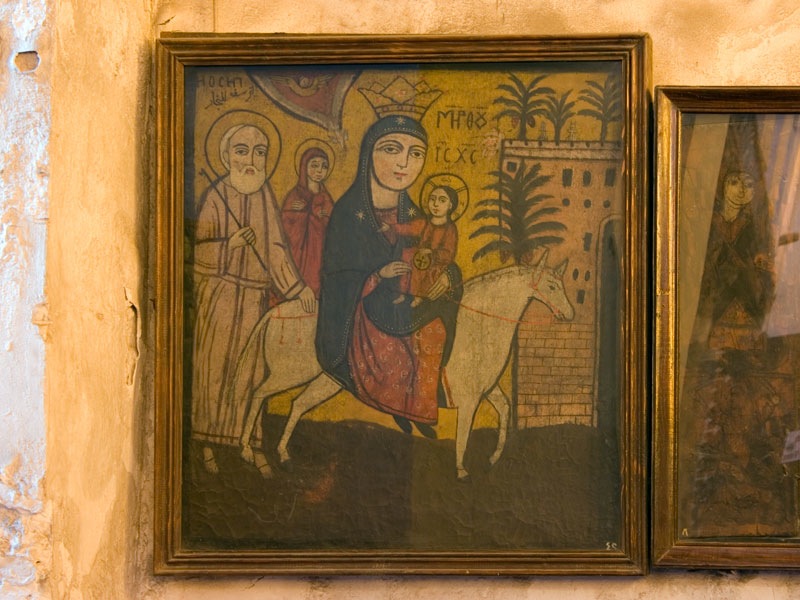
After this, the city started developing outside the walls of the fortress. There was a very small cave in the city where people would go to seek refuge and live. So when the Holy family: the Virgin Mary, Joseph the Carpenter, baby Jesus and the midwife Salome (who accompanied them) fled from Palestine, they came to this cave. This is now underneath a church named Abu Sarga which is located next to the Church of the Martyr Saint Barbara.
After Christianity spread in the 4th century C.E. the Roman Empire adopted Christianity as the state religion, Roman authorities living around this area heard that the cave had been inhabited by the Virgin Mary. Hence, built a church on top of it named Abu Sarga for two martyrs belonging to the patriarch of Constantinople. It became a small church where the Romans prayed. This church is the oldest church (in Egypt) from the 4th century C.E.
Within the walls of the fortress was a group of Roman Orthodox who built a church for themselves named Mar Girgis in the 10th century C.E. There was also a group of Jews who bought a church from the Orthodox Copts named for the Angel Michael next to the Church of Saint Barbara turning it into a synagogue named Ben Ezra.
When Amr Ibn Al-‘As expanded the Islamic empire into Egypt he established another town nearby named Fustat and in it a mosque named Amr Ibn Al-‘As. He built the foundation for a large city with streets, parks and luxurious buildings. History states that Coptic architects, engineers and craftsmen contributed their ideas.
 In this period other churches were built in Fustat: The Church of Abu Sayfayn, the Church of the Virgin and the Church of his Holiness Father Shenouda. Furthermore, a convent for nuns and this location started to expand greatly.
Old Cairo was also where the patriarch from Alexandria would come to meet with the Arab governors and discuss the state of the churches in this area also known as the area of Babylon.
From the early times of Christianity there were three famous bishoprics in Egypt: Old Cairo or Babylon, Memphis (Capital of Ancient Egypt) and Ouseem.
The fortress has also produced Patriarchs and has been a center of learning for the patriarchic fathers. His Holiness Father Michael the 46th was said to be part of the Church Abu Sarga which is next to us now. There have been many famous bishops who emerged from here throughout history.
In the 13th century, Monk Boulus al-Boushi and also from among the famous priests is Ibn Khabar who was the pastor of the Hanging Church in the 14th century. Amongst the famous who were present was the monk Boutros Ibn T’abaan who lived here in the Hanging Church. His educators were the sons of ‘Asaal who were famous in Church history.
Also the liturgical cantor famous from this Church (the Hanging Church), Abu Shaakir Rahib Abu al Karam Boutros has been written about in famous books which exist in the libraries of ancient churches. We cannot forget the Saint Sam’aan Al-Kharaaz who is known from the Church of the Mountain Muqattam. Finally, Barsoum Al-Aria’an, whom was present in the Church of Abu Sayfayn.
During the days of Father Theodosios II (1298 C.E.) the chrism of the Hanging Church was completed and 25 bishops contributed to its making. Not to mention the famous architect S’aid Ibn Al-Kaatib Al Fara‛aani, the contemporary of Ahmed Ibn Tulun, who designed and made the nilometer in Rhoda and the designer of the mosque of Ibn Tulun, a masterpiece of architecture.
In the place where I stand, came many prominent people. It was the seat of the Patriarch after it left from Alexandria. The Hanging Church witnessed the naming of 11 Patriarchs and two in the Church of Abu Sayfayn.
Another piece of information is that this area is called the “wax castle”. It is so called because when Amr Ibn Al-‘As and his troops surrounded the fortress at night the Copts and the authority in Rhoda (as it is known today) would give signals with lights to each side and each would understand. Arab historians said that there was a castle with lit candles in it and this is how it acquired its name. This is just a quick historical insight of the significance of Old Cairo.
 Currently, it is considered a visiting site for all those who desire to visit ancient places and you notice tourists coming daily to visit this place or that. Egyptians or anyone who is Christian feel they must come to these sites for the antiquities in them. It has become a ray of antiquities, monuments, and churches. It is a spark of light to anyone who wants to know about Christianity in Egypt because Christianity in Egypt stems from this location. Another significance of this location is the presence of the famous popular saints and it is present in their birthday celebrations and many people come to celebrate.
 As for the Holy Family, when the divine command came to Joseph the carpenter to come to Egypt fleeing from the tyrant Herod in the year 3 C.E. Mary, Jesus and the midwife who witnessed the virgin birth came from Palestine and entered Sinai on the Northern side in the city of Farma (today between el-‘Areesh and Port Said). They then went down to the city of Tell al-Basta in Sharqiyya following Mostorod, Belbeis and Sammanoud, Qafr al-Sheikh and afterwards directly to Wadi el-Natrun in the western desert.
Something miraculous happened there and whoever visits Wadi el-Natrun knows of the spring of Mary. When the baby Jesus got thirsty God sprang for them very sweet water and this spring still exists and is surrounded by salt lakes. Of course it is a miracle that fresh water exists amongst these lakes. It is still known as Mary’s spring today.
After the western desert, they moved on to Matariyya, Ain Shams and then they came to Old Cairo. However, before they came to Old Cairo, they went to an alley called Zuweila in which now is a church called the Church of the Virgin. So they came to Old Cairo and the Virgin settled in the cave (below the church of Abu Sarga) that is now a visiting site for anyone who desires to smell the holiness and sweetness of the place blessed by the Virgin Mary, Joseph the Carpenter and the Baby Jesus.
 There are many Churches in Fustat: Mercurius, the Convent of Father Shenouda, the Church of the Virgin, Abu Sayfayn, the Church of the Monk Father Shenouda, the Church of the Father of Babylon, the Church of Amir Tadros, the Church of the Angel Michael, the Church of Mar Mena from the days of his Holiness Father Kyrillos IV.
We made a CD that includes beautiful pictures of relics, icons, antiquities and churches. Also visible is the beautiful celebrations from the Church of Mar Girgis. There are examples how we pray, how we revere him, like we treat relics, how we go around (benediction) the church with the cross and devotional singing. Afterwards, we go to the convent of Mar Girgis and this is a representation of the similar fashion we celebrate of all the saints (for example Abu Sayfayn or Saint Barbara) and remember their martyrdom and their lives.
This is the conclusion to the discussion of Old Cairo.
THE HISTORY OF THE BABYLON FORTRESS
In “A Guide to the Ancient Coptic Churches of Cairo”, O.H.E. KHS-Burmester records significant historical information about the fortress area. According to him, Ptolemy (121-151 A.D.), in his book “Geography”, mentions a town named Babylon which existed from Pharaonic times on part of a site of what is now included in Cairo.
A canal ran through this town connecting the Nile with the Red Sea. Roman Emperor Trajan (98-117 A.D.) reopened this canal and also enlarged and equipped a fortress which was located at the southern end of the town. The fortress, known as the “Castle of Babylon”, or “Castle of Egypt” (Khemi), was further enlarged by Emperor Arcadius (395-408 A.D.). There was a fluvial port at this location where ships could anchor. In 335 A.D., the Roman Emperor altered shipping routes from Alexandria to the Babylon fortress. The area of Old Cairo was the first nucleus of present-day Cairo.
It is not known exactly when this city became a bishopric but it must have been before the first half of the 5th century as a certain Cyrus, Bishop of Babylon, was present at the Council of Ephesus held in 449 A.D.
At the time of the Arab conquest of Egypt, Babylon seemed to have been a large city extending northwards as far as Tendounias (‘Um Dunain’), the present district of al-Azbakiah, where there was a fortified outpost. The Arab general ‛Amr Ibn al-‘As captured this outpost and occupied the city as far as the Castle of Egypt, to which he laid siege. On April 9th, 641 A.D. this castle, which the Arabs named “Qasr ash-Sham’a (wax castle) surrendered. After the Arab conquest of Egypt, the name Babylon was more commonly used to denote the district immediately around the Castle of Egypt or Qasr ash-Sham’a. Eventually this became a quarter inhabited mainly by Christians.
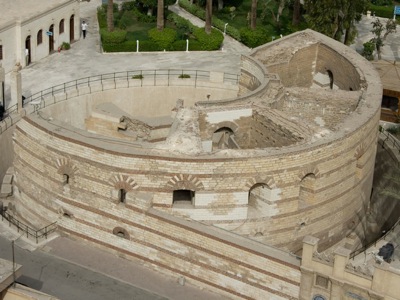
This fortress is similar to the Roman ones found in Europe and North Africa. At one time the course of the River Nile flowed under the fortress walls at the Roman Orthodox St. George’s Church. Roman methods of construction used a pattern of five blocks of limestone with three blocks of red bricks. The fortress, as well as older parts of the church, contain such patterns in their foundations.
The fortress’ towers are almost 10 meters high and 31 meters in diameter. The walls are almost 3 meters thick. The floor of the fortress is below the level of St. George Street by about 6 meters due to city construction over time.
Churches
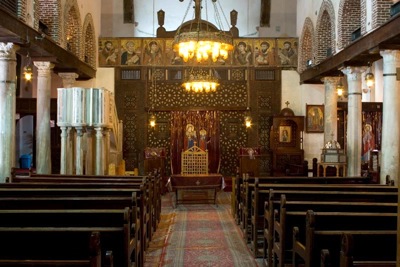
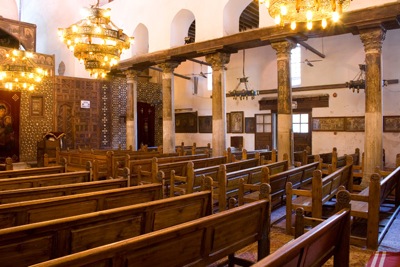
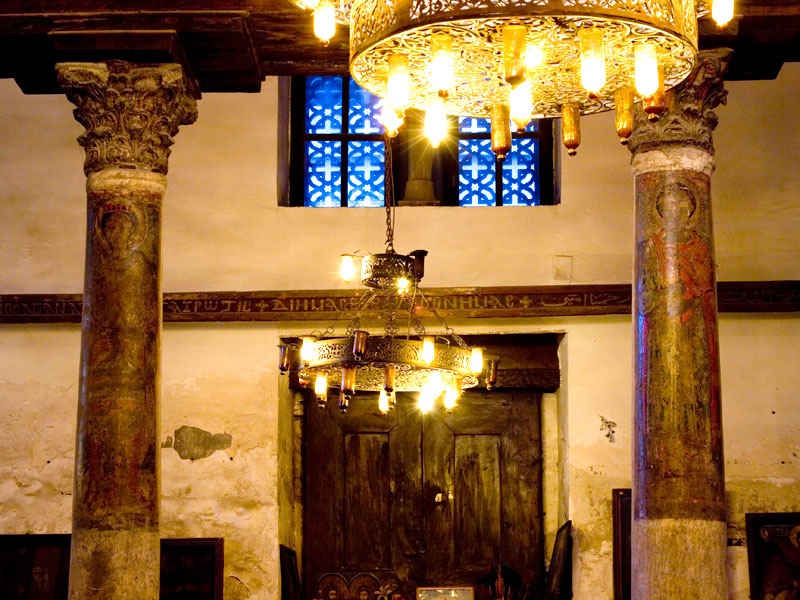
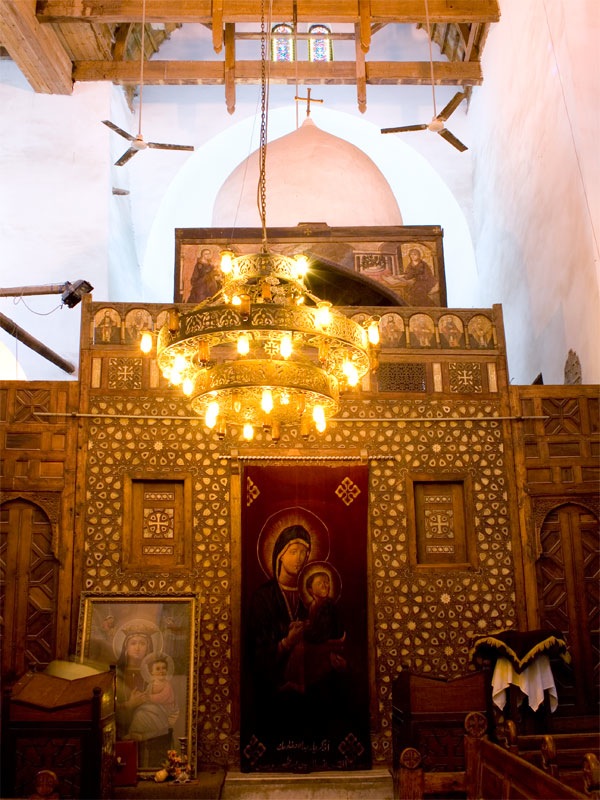
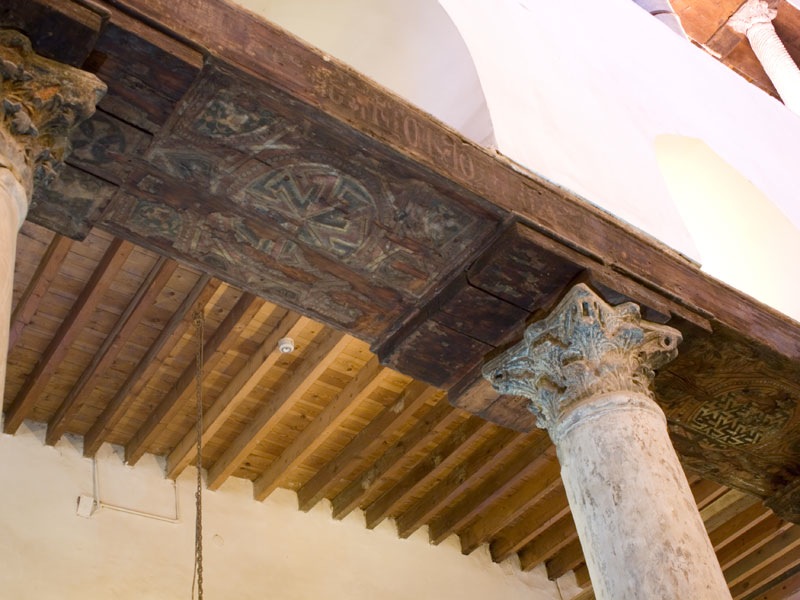
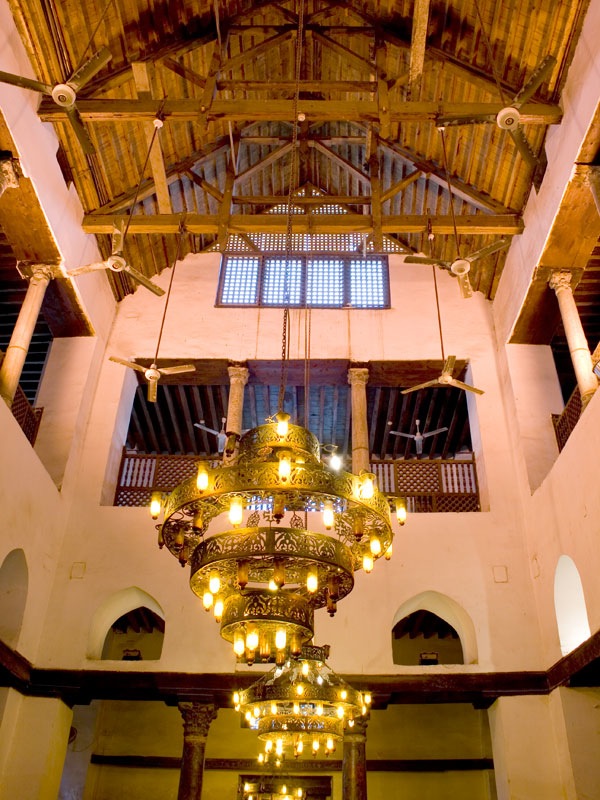
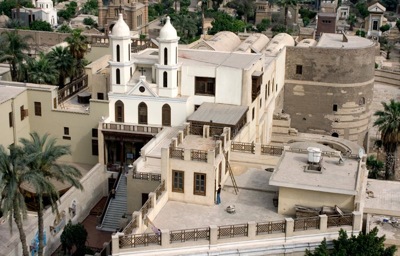
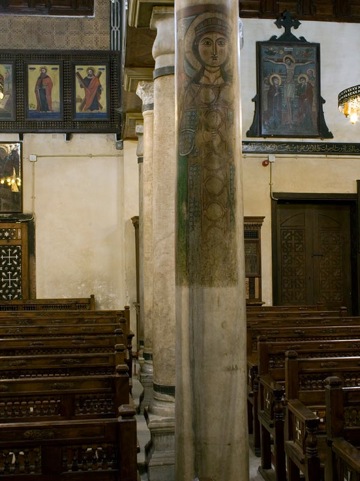
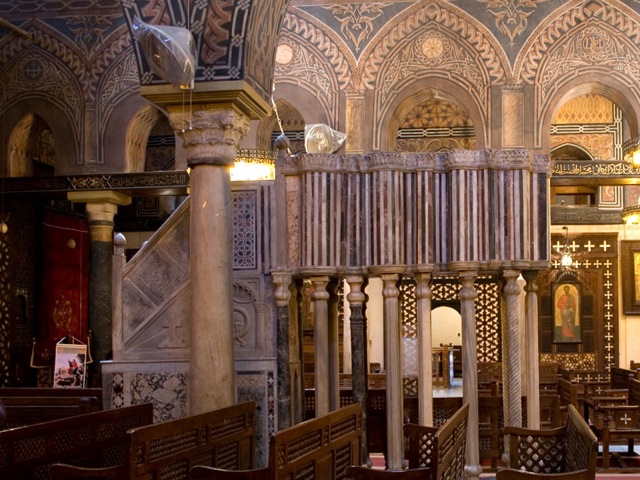
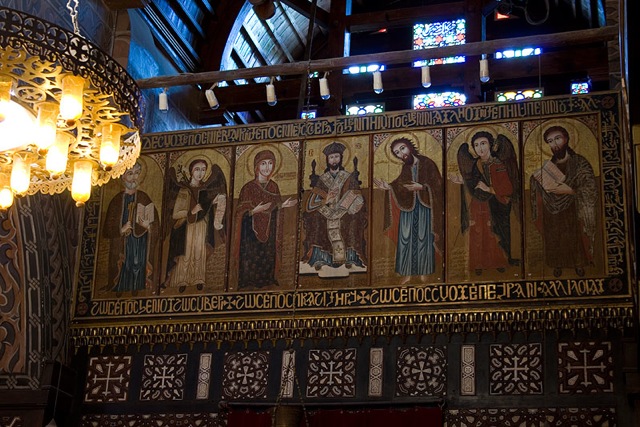
Known in Arabic as al-Muallaqah ("The Suspended"), the Hanging Church is the most famous Coptic church in Cairo. The church is dedicated to the Virgin Mary and is thus also known as Sitt Mariam or St. Mary's Church.
The Hanging Church is named for its location above a gatehouse of the Roman fortress in Old Cairo; its nave is suspended over a passage. The church is approached by 29 steps; early travelers to Cairo dubbed it "the Staircase Church." Read More ...
Saints Sergius and Bacchus Church (Abo Serga )
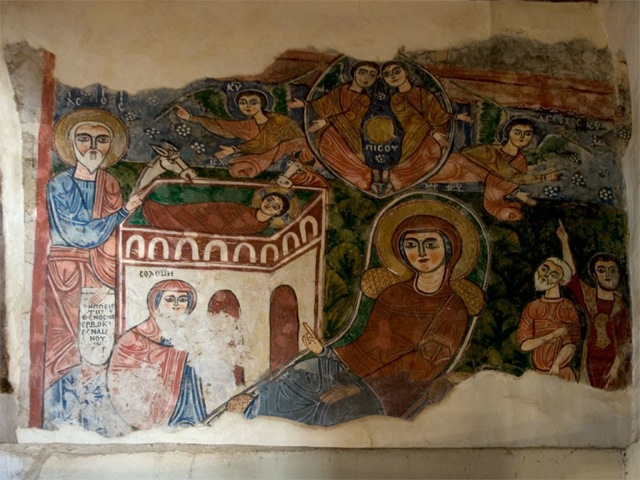
 Saints Sergius and Bacchus Church is traditionally believed to have been built on the spot where the Holy Family, Joseph, Mary and the infant Jesus Christ, rested at the end of their journey into Egypt. They may have lived here while Joseph worked at the fortress.
The church is of significant historical importance, and in fact, it is where many patriarchs of the Coptic Church were elected. The first to be elected here was Patriarch Isaac (681-692) It is the episcopal church of Cairo, and it was the episcopal See of Masr (the district of Old Cairo) that replaced the former See of Babylon. Many bishops of the See were consecrated in the Church until the reign of Patriarch Christodulus (1047-1077). Read More ...
Saint Barbara Church
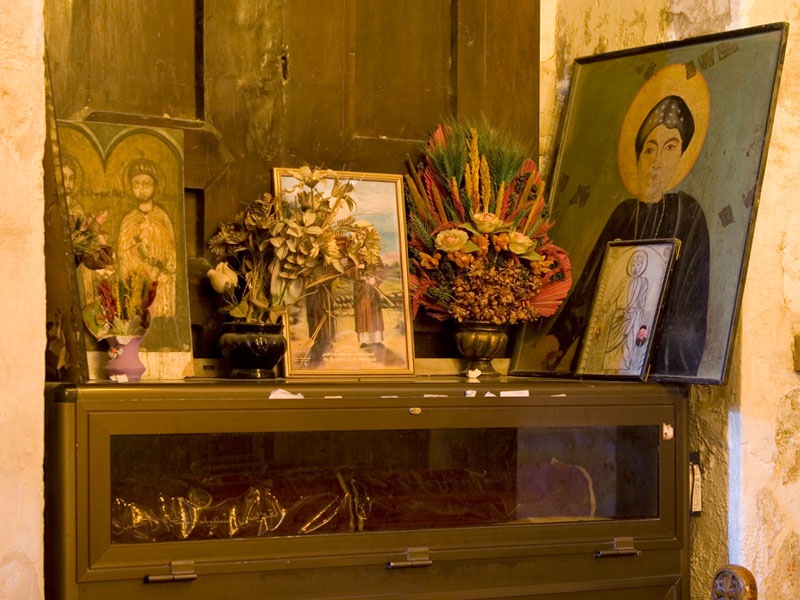
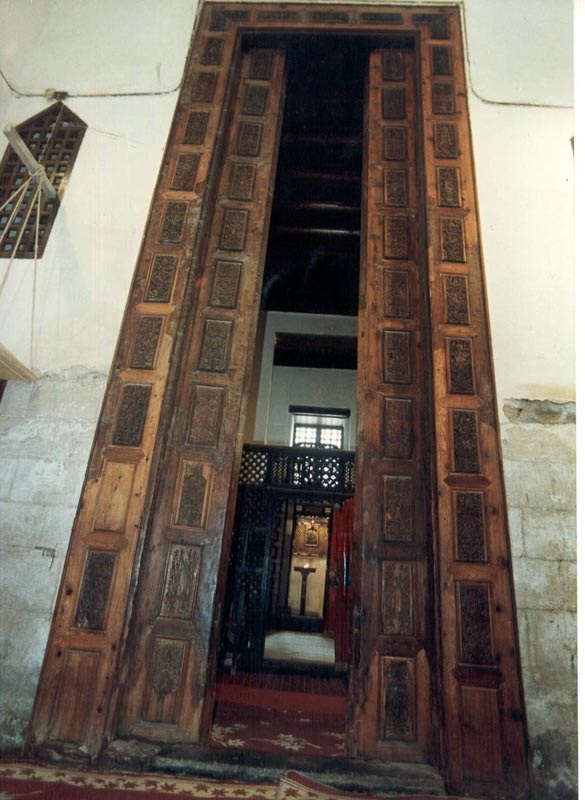
 The church of St. Barbara is among the churches of Old Cairo of historic importance. It was originally dedicated to St. Cyrus and St. John who were worshipped for their healing powers. A small church at the northeastern corner of the building commemorates these two martyrs. Documents from the 13th century mention that the relics of St. Barbara were kept in this church. Many of its precious items, like two door panels, a wooden screen, an icon and Bible caskets were transferred to the nearby Coptic Museum. The basilican structure and tripartite sanctuary of the church closely resembles the one of Abu Sarga. The church of St. Barbara houses some of the rarest icons.
These are the words spoken by our Lord Jesus Christ to St. George before his martyrdom. From the manuscript of St. George kept in St. George’s Convent in Old Cairo:
“I swear by myself, my beloved George, that as there was no one borne of woman greater than John the Baptist, also no martyr resembles you. You will have no counterpart among them. I made your name spread in my kingdom and gave it grace and made it a port of safety for all mankind. Whoever, in distress, calls on your name, either man or woman, I will quickly answer and give them their heart’s request.” Read More ...
 ST.GEORGE (GREEK ORTHODOX)
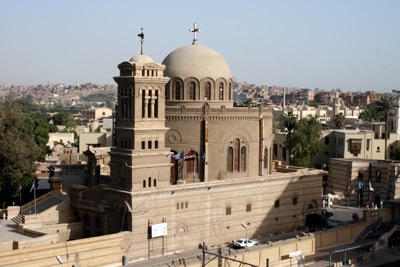
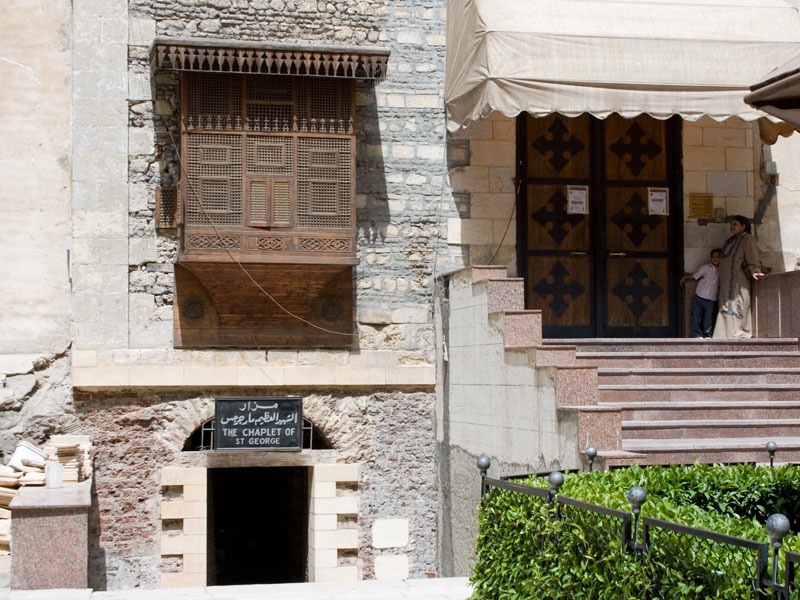
The Greek Orthodox Church of St. George was erected upon the northern tower of the Fortress of Babylon and echoes its round shape. The church can be reached through a flight of stairs and is crowned by an impressive dome. Tradition has it that St. George was kept in a prison close to the church and martyred there. The present building dates from the beginning of the 20th century. Read More ...
SYNAGOGUE
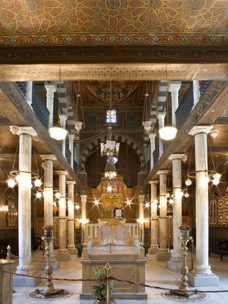
The Synagogue of Ben Ezra was originally a church. However, it needed to be sold to pay the annual taxes imposed on the church by the government in 882 A.D. The synagogue is named after Abraham Ben Ezra who bought the church for a sum of 20,000 dinars. The basilican structure with a nave and two aisles is still recognizable. The synagogue has become famous for its Geniza, an archive of ancient Jewish manuscripts, comprising thousands of rare manuscripts. Read More ...
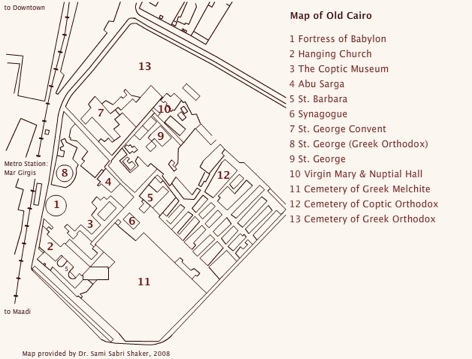
Map of Old Cairo

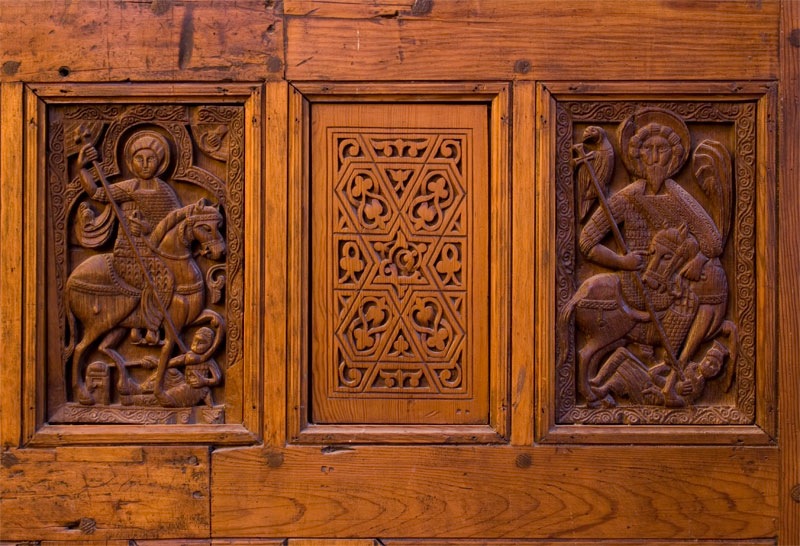
 The Coptic biography of Saint George does not mention his flight with and victory over the dragon. Hence, scholars believe that around the fourteenth century this theme was a transferal from the biography of St. Theodore Stratelates to Saint George, though it is also possible that the Copts adopted this tale from the Western Christians.